|
#979 (4/10/26)
|
|
|
BY TONY FOURNIER |
|
This article is about Red Robin Records, located in Harlem, New York City. Bobby Robinson had a record store which opened in 1946, named "Bobby's Record Shop", near the Apollo Theatre. As talent was nearby and accessible, it was a good business decision to start a record company.
Red Robin Records was formed by brothers Bobby and Danny Robinson in November 1951. The label produced about 40 releases, more than half of which were vocal group records, before closing in 1956. After Red Robin, Bobby Robinson formed the Whirlin Disc* (1956-1957), Fury (1957-1959), Fire (1959-1962), and Enjoy (1962-1985) labels. (*Jerry Blaine of Jubilee Records was co-owner.) |

|
|
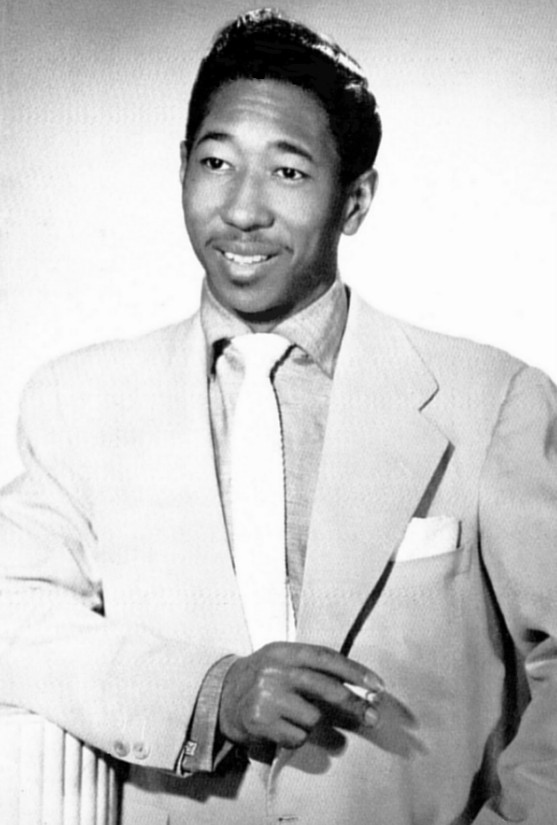
Above Left: Photo of Bobby's Happy House Records shop, circa 1960s. Note the speaker in front of the store. Above Right: Photo of Bobby Robinson, co-owner and operator of Red Robin Records, looking debonair.
CHAMPION JACK DUPREE

|
Above: Champion Jack Dupree, originally from New Orleans, was a boogie woogie pianist and blues singer. His first career was as a prize fighter. Jack fought 107 bouts, winning a "Golden Gloves" and other championships, thus his name "Champion Jack". When Jack was thirty, he moved to Chicago (circa 1940) and became interested in performing his music and having it recorded. He had records on Columbia/OKeh (1940-1942), Asch (1944), Continental (1945), Joe Davis (1945-1946), Apollo (1951), Red Robin (1952-1954), King (1953-1956), Groove/Vik (1956-1957), and Atlantic (1959-1961).
|

|
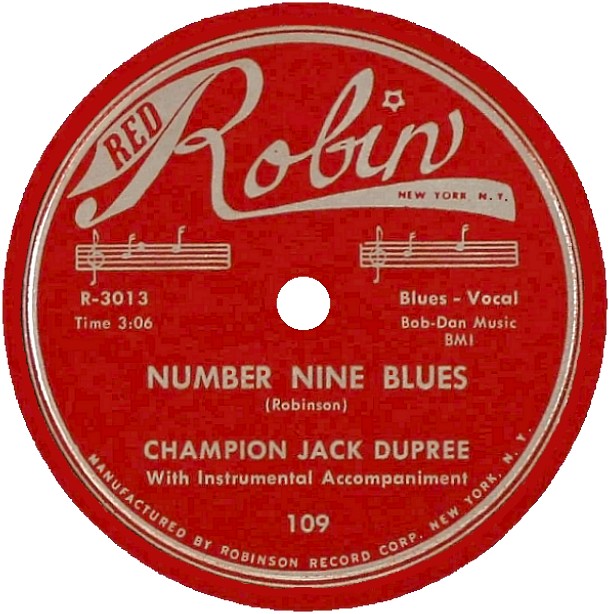
Above Left: Label image of Red Robin 109, released in 1952. Champion Jack Dupree had three records on the Red Robin label... numbers 109, 112, and 130. The musicians on #109 are Jack Dupree (piano), Brownie McGhee (guitar), Stick McGhee (guitar), Bob Harris (bass fiddle), and Willie Jones (drums). For "Number Nine Blues" and "Highway Blues", add Sonny Terry (harmonica).
The labels show "Robinson" as composer for "Number Nine Blues" and "Dupree" for "Stumbling Block Blues", but neither song is registered at BMI.com. That's interesting because the labels refer to "Bob-Dan Music" publishing company, so it would be in Bobby Robinson's interest to register the titles.
Above Right: Label image of Red Robin 112, released in 1953. Based on matrix numbers, all four of the above sides were recorded in the same session.
The labels for both sides give "Dupree" songwriting credit.
There are 95 "Highway Blues" titles registered at BMI.com. None give credit to Dupree. And none give credit to (Bobby) Robinson. However, one of the listed composers is "Robert A. Shad", owner of the Sittin' in with label in New York City.
Shad had been interfacing with Dupree since the late 1940s and eventually recorded him on his brother's Harlem label in 1955 (see further below on this page).
BMI.com gives credit to "William Jack Dupree" as composer of the flip, "Shake Baby Shake".
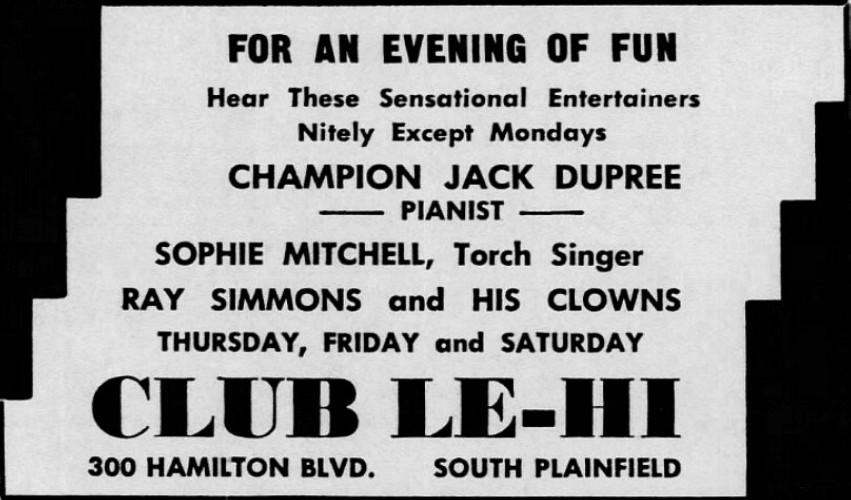
At Direct Right: COURIER-NEWS (Bridgewater, New Jersey), March 22, 1946.
LISTEN (Windows Media Player):
1. "Number Nine Blues" - Champion Jack Dupree - Red Robin 109 - 1952.
2. "Stumbling Block Blues" - Champion Jack Dupree - Red Robin 109 - 1952.
3. "Shake Baby Shake" - Champion Jack Dupree - Red Robin 112 - 1953.
4. "Highway Blues" - Champion Jack Dupree - Red Robin 112 - 1953.ALL FOUR SONGS played in sequence.

|
|
EXTRA RECORD — JACK DUPREE
|
|
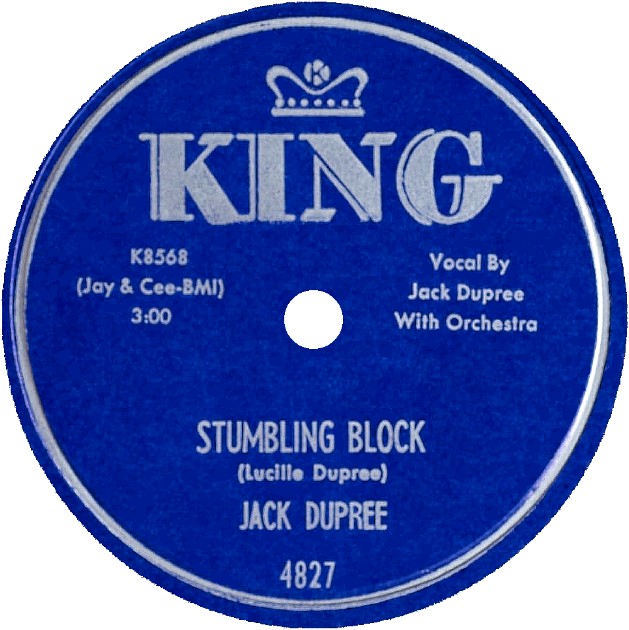
Above Left: Label image of King 4827, recorded in June 1955 and released in 1955. Jack had twelve records issued on the King label. This is the same song as "Stumbling Block Blues" on Red Robin, but re-recorded for King Records.
The musicians on this record are Jack Dupree (piano), Willis Jackson (tenor sax), Mickey Baker (guitar), Ivan Rolle (bass fiddle), and Calvin Shields (drums).
BMI credits "Lucille Dupree" as the composer of "Stumbling Block". Interestingly, BMI also credits "William Jack Dupree" separately for writing the song. Lucille was Jack's wife from 1948-1959. Many of his songs have her name on the label as the composer, including this record's flip-side, "That's My Pa". Was Lucille a songwriter or did Jack use her name as a pseudonym?
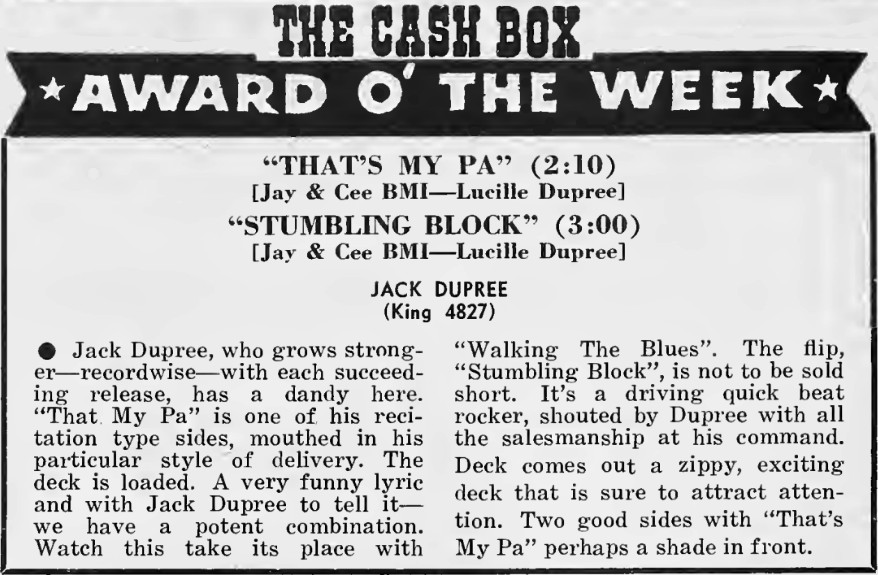
"That's My Pa" is done in Jack Dupree's often utilized recitation style, which means there isn't much in the way of actual singing.
Above Right: CASH BOX REVIEW, October 22, 1955.
At Direct Right: CHICAGO DEFENDER, September 29, 1945.
NOTE: Joe Davis was most famous for the many great releases by The Five Red Caps on his Joe Davis, Davis, Beacon, and Gennett labels (1943-1946).At Far Right: NEW YORK AGE, October 29, 1955.
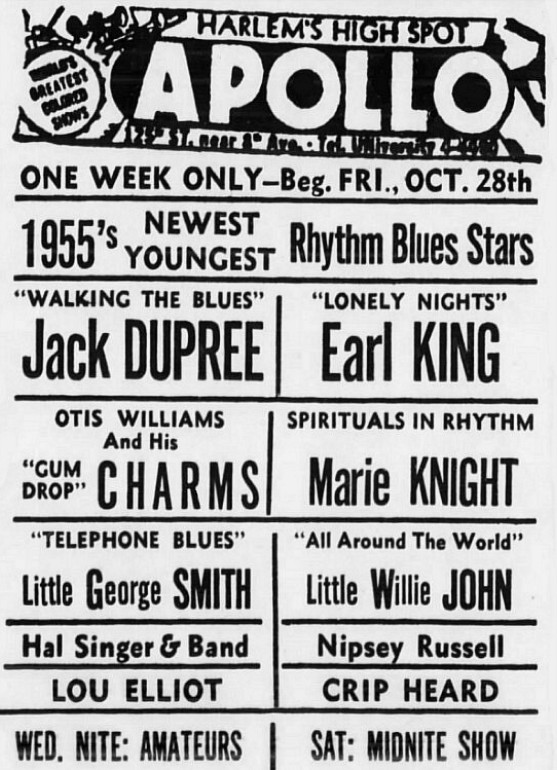
NOTE 1: What a great Apollo Theatre line-up, featuring three King Records' artists.
- The "Lonely Nights" Earl King is included in my Specialty Records - Part Five article.
(There was also another Earl King, at the time, who recorded for the King label.)
- Otis Williams And His Charms are included in my King Records - Part Eight article.
- Blues singer Little George Smith is included in my Modern Records - Part Seven article.
- Little Willie John is included in my King Records - Part Eight article.NOTE 2: Their top-billed artist, Jack Dupree, 45 years old and recording since 1940, wasn't exactly "1955's Newest, Youngest". Little Willie John, at 17 years old, seems to be the only listed artist to fit that description, although Earl King was only 21 years old.
The Billboard Review (10/22/55): JACK DUPREE — King 4827
Stumbling Block (79) With his previous disk still riding the charts, Dupree comes up with a most attractive follow-up, a fast blues with a rocking beat. Should be an outstanding seller, particularly juke-wise.(NOTE 1: A ratings range of 70-79 was considered as "good".)
(NOTE 2: His "previous disk" is "Walking The Blues", a big hit for him.)LISTEN (Windows Media Player):
1. "Stumbling Block" - Jack Dupree - King 4827 - 1955.
2. "That's My Pa" - Jack Dupree - King 4827 - 1955.BOTH SONGS played in sequence.

EXTRA RECORD — LIGHTNING JUNIOR AND THE EMPIRES

|

|
Above Left: The Empires, from mid-1955, (Top L-R) James Pender, William Goodman, Bobby Dunn, (Bottom L-R) Les Cooper, and John Barnes. Pender never recorded with them. For Morty Shad's New York City Harlem label, The Empires had two records on their own (1954-1955), one record backing "Lightning Slim" (1955), and one side backing Bobby Sue And Her Freeloaders (1955).
They also had three records on Mercury's subsidiary label, Wing (1955-1956); one on Mercury, as The Prestos (1955); and two on Bobby Robinson's Whirlin Disc label, one of those as by The Whirlers (1956-1957).
Above Right: Champion Jack Dupree, also known as Lightning Junior. He probably didn't use his real name on Harlem because he was under contract to King Records at the time.
Lightning Junior/Champion Jack Dupree had only one record on the Harlem label. Interestingly, Lightnin' Hopkins had four records on that label, including Harlem's first and last releases (1954-1955).
Click HERE for an article about The Empires by Marv Goldberg. (Will open in a separate window)

|
|
The Empires were available at the time (they were recording their own "Magic Mirror"/"Make Me Or Break Me" released on Harlem 2333), so they were used for back up vocals on the two above records (three sides). Above Left: Label image of Harlem 2334, released in May 1955. BMI.com credits only "Robert A. Shad" for composing "Ragged And Hungry". The label seems to credit "Morty Shad", who was Bobby's brother and the owner of Harlem Records.
The flip-side, "Somebody Changed The Lock", has the same "L. Dalton-M. Shad" on the label, but, again, BMI.com credits only "Robert A. Shad". The actual composer is "William Welden", who wrote "Somebody Done Changed The Lock On My Door" for a 1945 Louis Jordan record, the flip-side of his big hit "Caldonia". One way to easily steal composer credits at that time was to change the song title wording.
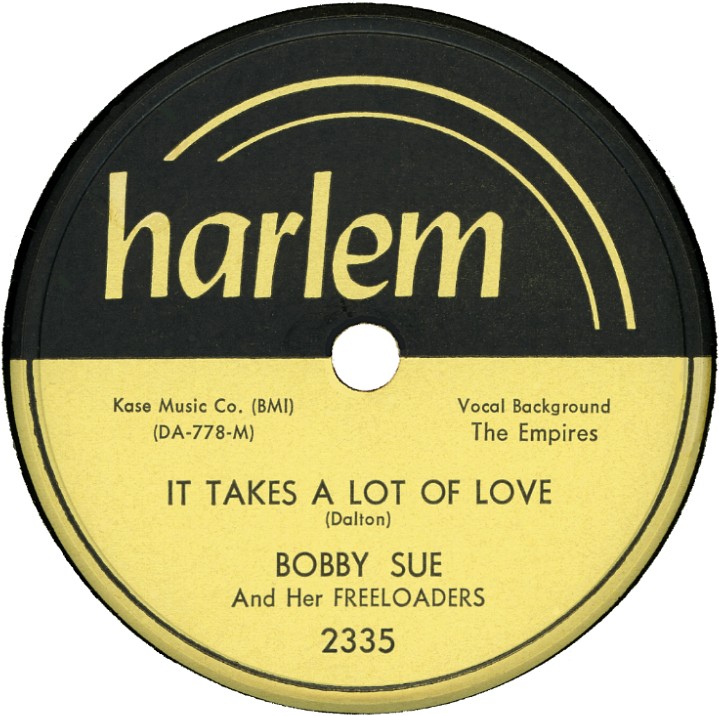
Above Right: Label image of Harlem 2335, also released in May 1955. The mysterious "Dalton" shows up again as composer on the front and back labels. BMI.com does not list any songwriter with the name "L... Dalton". But no matter, Bobby Shad has full BMI credit for both sides.
During the song "It Takes A Lot Of Love", the lyric "lot of love" is sang thirty times. Count 'em! The flip-side, "Relief Check", does not have any vocal group backing.
At Direct Right: Photo of The Empires from late 1954, (L-R) John Barnes (lead tenor), Bobby Dunn (baritone), Les Cooper (tenor), and William Goodman (bass). This is the line-up for all of The Empires' records.
Cash Box Review (5/21/55):
LIGHTNING JUNIOR — HARLEM 2334
Ragged And Hungry (C+) Lightning Junior sings a slow country type blues about the tortures of being down and out. Routine wax.
Somebody Changed The Lock (C+) Lightning Junior wails an uptempo Latin flavored blues. He's been locked out and told to stay away. A rhythmic effort that comes off ok.(NOTE: A rating of C+ was considered as "good".)
The Billboard Review (5/21/55):
LIGHTNING JUNIOR — HARLEM 2334
Somebody Changed The Lock (74) Good lyric idea coupled with a traditional blues, and it's sung with heart by Lighting Junior to a good backing. Watch it.
Ragged And Hungry (74) Another good blues, Junior and his group have sound and style.(NOTE: A ratings range of 70-79 was considered as "good".)
LISTEN (Windows Media Player):
1. "Ragged And Hungry" - Lightning Junior And The Empires - Harlem 2334 - 1955.
2. "Somebody Changed The Lock" - Lightning Junior And The Empires - Harlem 2334 - 1955.
3. "It Takes A Lot Of Love " - Bobby Sue And Her Freeloaders (Vocal Backing By The Empires) - Harlem 2335 - 1955.ALL THREE SONGS played in sequence.

Cash Box Review (6/4/55):
BOBBY SUE — HARLEM 2335
It Takes A Lot Of Love (C+) A rhythmic calypso flavored ditty with a touch of religious performed in ok manner. Both sides for the down home market.The Billboard Review (6/11/55):
BOBBY SUE — HARLEM 2335
It Takes A Lot Of Love (68) Chorus wails in back of this shout, and Creole rhythm gives it an unusual flavor. Could do some Southern business.(NOTE: A ratings range of 40-69 was considered as "satisfactory".)
SONNY TERRY — BROWNIE McGHEE
|
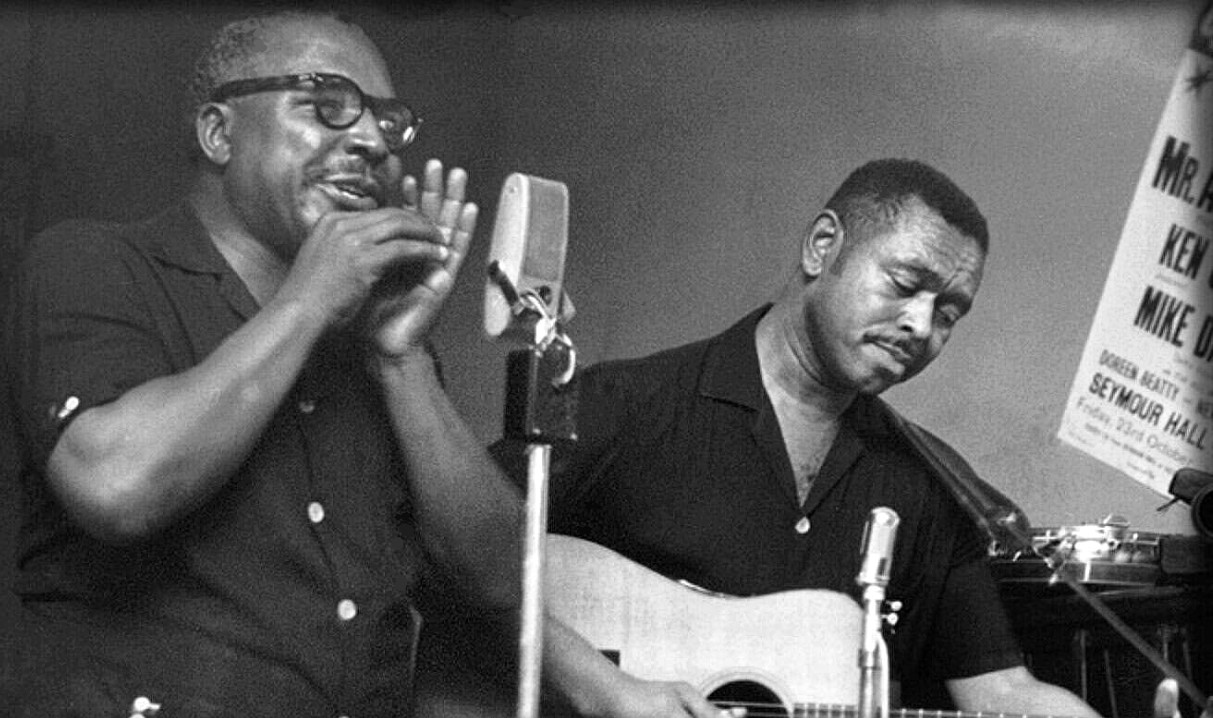
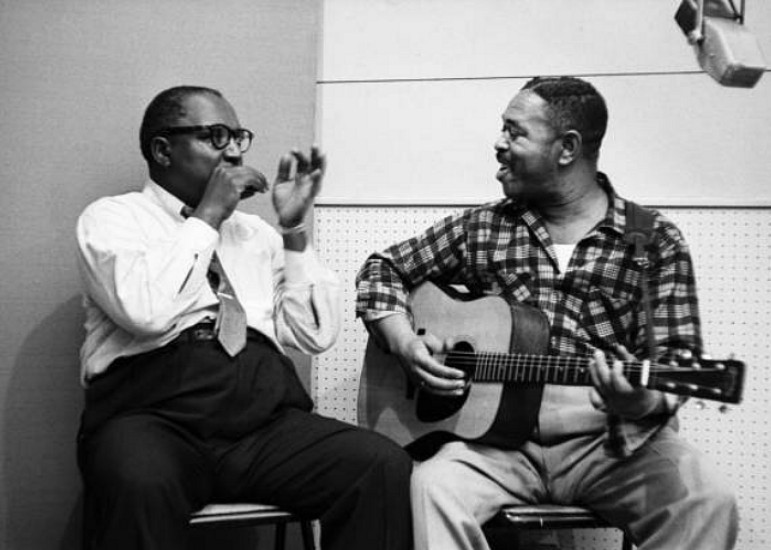
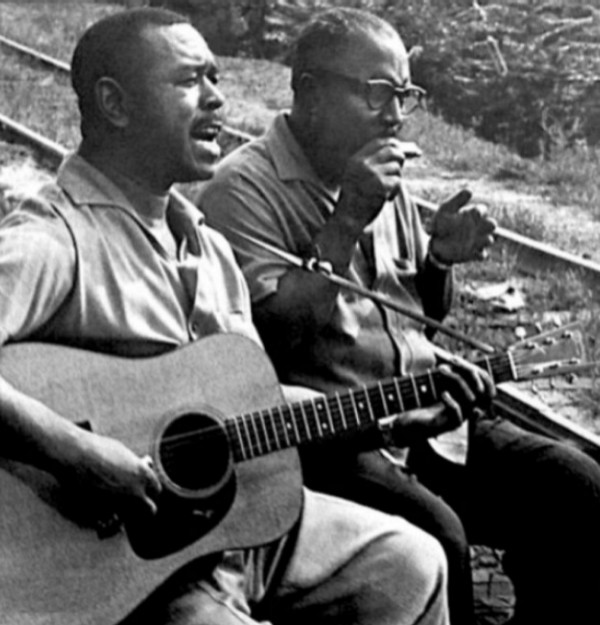
Above: Photo of Sonny Terry And Brownie McGhee, circa 1953. They were both blues singers, Sonny played harmonica and Brownie played guitar. The two started performing together in 1942. It was very common and usual for Brownie and Sonny to instrumentally backup each other's singing on records, not always with full credit for both on the label. If you hear a Brownie McGhee record and there is a harmonica, it's a good bet that it's Sonny Terry. By the way, Sonny was blind which might explain why he is sitting in photos of him. Notice that his right eye is shut. Brownie is also shown sitting in photos, not only because he is pictured with Sonny, but also due to a bad right leg from polio as a child.
|
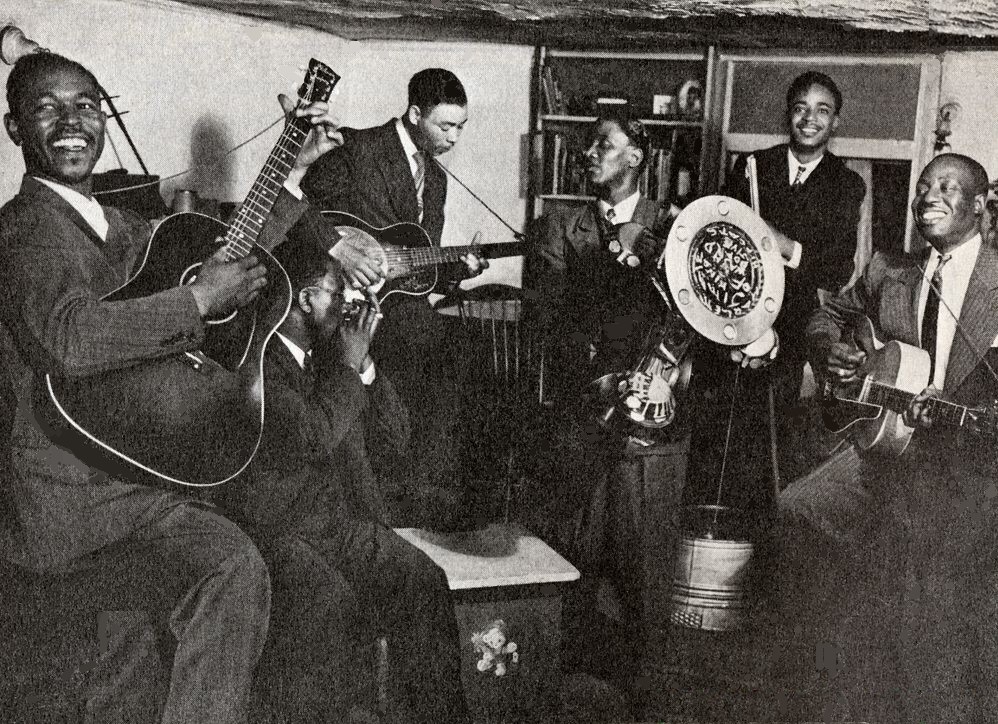
Above: Photo of (L-R) Brownie McGhee, Sonny Terry (sitting), Sticks (aka "Stick") McGhee, Washboard Jimmy King, Bob Harris, and Big Bill Broonzy in a jam session. Sticks was Brownie's brother and also a guitar player, most known for "Drinkin' Wine Spo-Dee-O-Dee", a #2 r&b hit in 1949 on the Atlantic label.
Terry.jpg "Red Robin 110 Label Image")
|
|
Above Left: Label image of Red Robin 110, released in 1952. Brownie McGhee plays guitar on this record. Also, probably Bob Gaddy on piano. Sonny's "Hootin" nickname was probably for his propensity of "hooting" during his songs. Grammercy Records released his "Hootin' Blues" in May 1952.
The label for "Doggin' My Heart Around" shows "Terry" as the songwriter. However, Bobby Robinson claims all rights to the song at BMI.com. Both the flip-side label and BMI.com credit Sonny and Bobby as the composers.
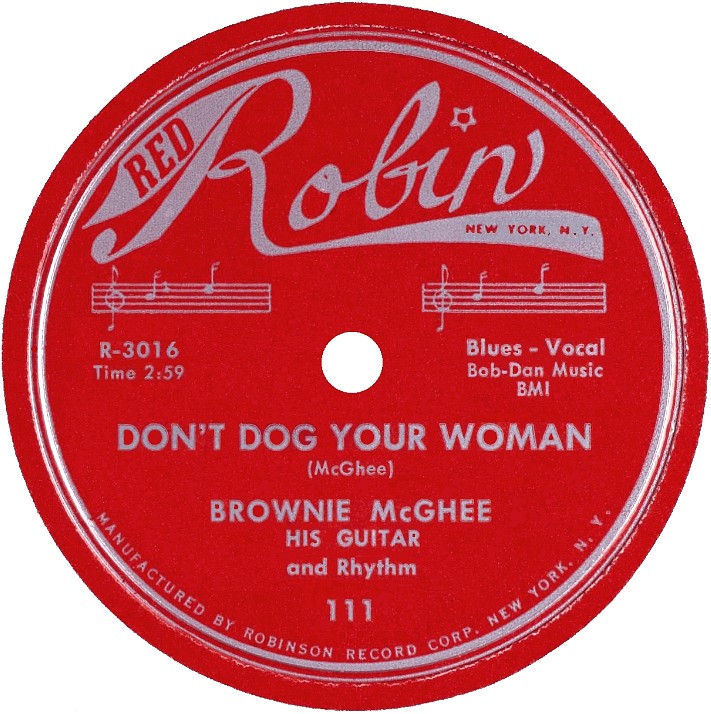
Above Right: Label image of Red Robin 111, released in 1952. For sure, Sonny Terry's harmonica is backing Brownie on this record.
Both front and back labels show "McGhee" as the lone composer. There are two separate entries at BMI.com for "Don't Dog Your Woman", one crediting "McGhee" and the other "Robinson". The flip-side has a single entry at BMI.com crediting "McGhee".
At Direct Right: Photos of Brownie McGhee and Sonny Terry.
Cash Box Review (2/21/53):
BROWNIE McGHEE — RED ROBIN 111
Don't Dog Your Woman (B) Brownie McGhee dishes up a moderate tempo tune with moralizing lyrics. Backing is potent and Brownie's chanting and guitaring makes this a fine dish.
Daisy (C+) Flip is a very similar item handled in like manner.(NOTE: A rating of B was considered as "very good" and C+ as "good".)
By the way, Brownie was married to "Ruth", not "Daisy", at the time.
LISTEN (Windows Media Player):
1. "Doggin' My Heart Around" - Sonny (Hootin) Terry And His Night Owls - Red Robin 110 - 1952.
2. "Harmonica Hop (Instrumental) " - Sonny (Hootin) Terry And His Night Owls - Red Robin 110 - 1952.
3. "Don't Dog Your Woman" - Brownie McGhee - Red Robin 111 - 1952.
4. "Daisy" - Brownie McGhee - Red Robin 111 - 1952.ALL FOUR SONGS played in sequence.

EXTRA RECORDS — SONNY TERRY AND BROWNIE McGHEE
|
|
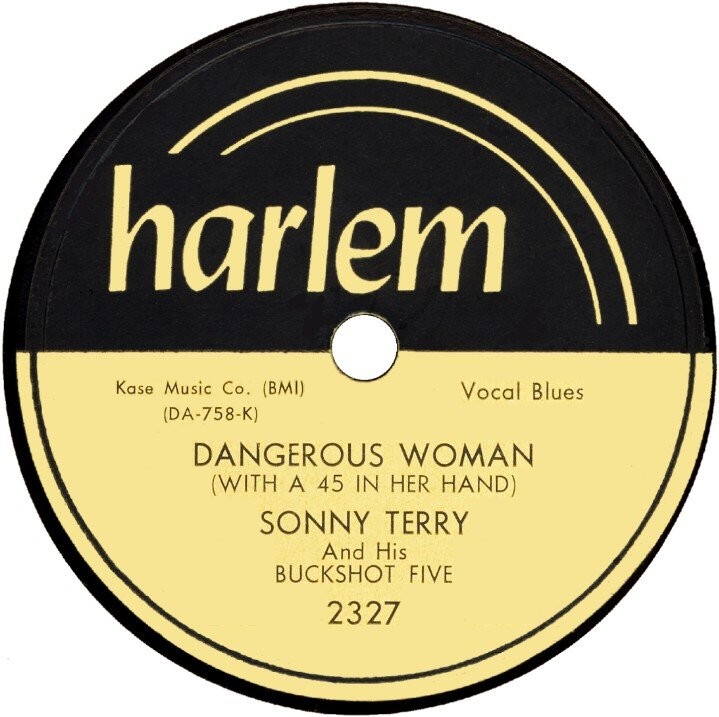
Above Left: Label image of Harlem 2327, released in 1954. Neither side's label of this record shows a composer. BMI.com credits "Dangerous Woman" to "Robert Ellen", who was actually Bobby Shad, and the flip, "I Love You Baby", to "Robert A. Shad". The Harlem label was owned by Bobby Shad's brother, Morty Shad. Robert Ellen is credited with stealing, err, I mean composing 1,336 song titles. Wow! How was he ever able to leave the songwriting table!?
A different version of "Dangerous Woman" was also released by the Sonny Terry Trio on Gramercy in 1952, that label calling it "Traditional". The Sonny Terry Trio consisted of Sonny Terry, Brownie McGhee, and Coyal McMahan (playing the maracas). See label image at direct right. Incidentally, the "45" she's carrying in her hand is NOT a 45-rpm record!
Things happen in threes, so Sonny Terry did "Dangerous Woman" again, this time for Josie Records in 1957. Somehow the Josie label credits "Herb Moss", the owner of Gramercy Records, as the songwriter.
"Sonny Terry And His Buckshot Five" were Sonny Terry (harmonica, vocal), Bob Gaddy (piano), Brownie McGhee (guitar), Bob Harris (bass), and George Woods (drums).
Above Right: Photo of Sonny Terry and Brownie McGhee.
LISTEN (Windows Media Player):
1. "Dangerous Woman" - Sonny Terry And His Buckshot Five - Harlem 2327 - 1954.
2. "I Love You Baby" - Sonny Terry And His Buckshot Five - Harlem 2327 - 1954.
3. "Dangerous Woman" - Sonny Terry Trio - Gramercy GRC-1061 - 1952.BOTH SONGS played in sequence.

|

|
|
|
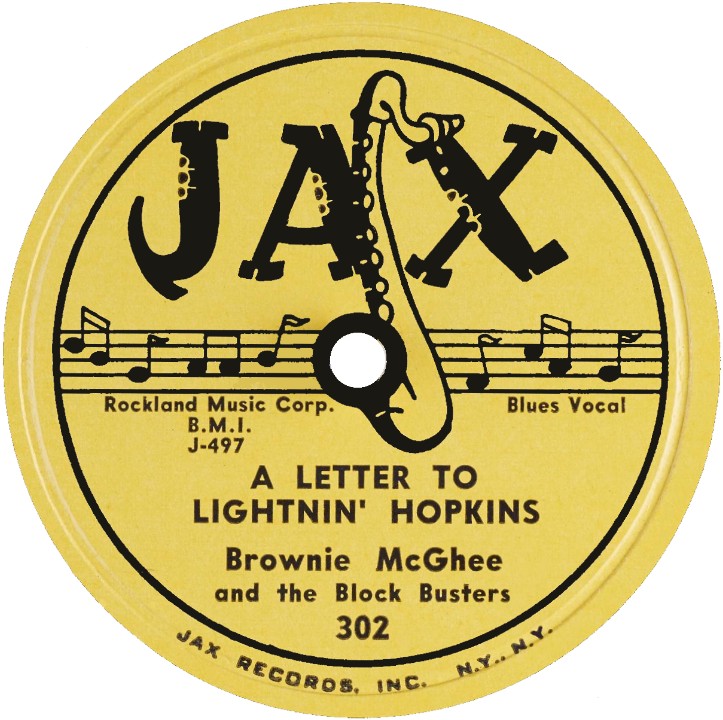
Above Left: Label image of Jax 302, released in 1952. On the "Letter" side, Brownie is going to Houston to take Sam's girl from him. "Samuel John Hopkins" is Lightnin' Hopkins' real name. Neither side's label on this record shows a composer. However, BMI.com credits "Robert A. Shad" as the songwriter of both sides. Bobby Shad and his brother, Morty Shad, owned the Jax label.
Regarding "A Letter To Lightnin' Hopkins", Hopkins had four records on the Jax label (1953-1954) and another four on the Harlem label (1954-1955), one of these a Jax reissue. He also had twelve on Sittin' in with (1951-1952), another Shad Brothers' label.
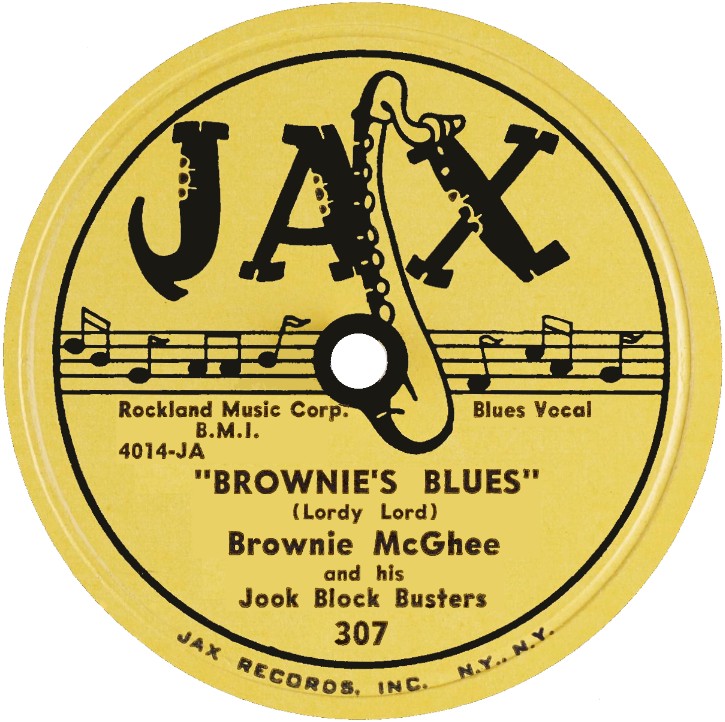
The (Jook) Block Busters were exactly the same musicians as The Buckshot Five (see members further above), except the vocal is by Brownie instead of Sonny.
Above Right: Label image of Jax 307, released in 1952. Both Jax 302 and 307 were recorded in the same session, which also produced Jax 304, 310, 312, and 322. For Jax 312, Al King plays tenor sax, while Sonny Terry's harmonica is not present.
LISTEN (Windows Media Player):
1. "A Letter To Lightnin' Hopkins" - Brownie McGhee And The Block Busters - Jax 302 - 1952.
2. "Smiling And Crying Blues" - Brownie McGhee And The Block Busters - Jax 302 - 1952.
3. "Brownie's Blues" - Brownie McGhee And His Jook Block Busters - Jax 307 - 1952.
4. "Meet You In the Morning" - Brownie McGhee And His Jook Block Busters - Jax 307 - 1952.BOTH SONGS played in sequence.
|
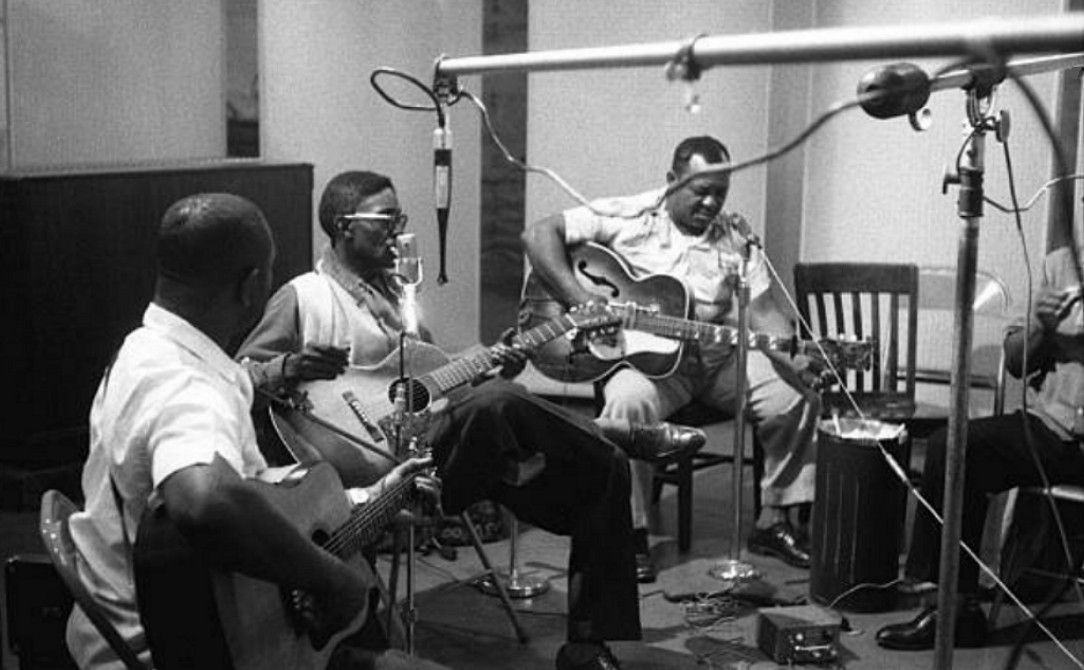
Above: Photo of (L-R) Brownie McGhee, Lightnin' Hopkins, Big Joe Williams, and Sonny Terry (partial view) in a recording session. Three guitars and one harmonica. This might have been done for the 1965 United Kingdom LP, "Lightnin Sonny & Brownie". Two of the tracks include the named artists, along with Big Joe Williams.
Keeping It In The Family....
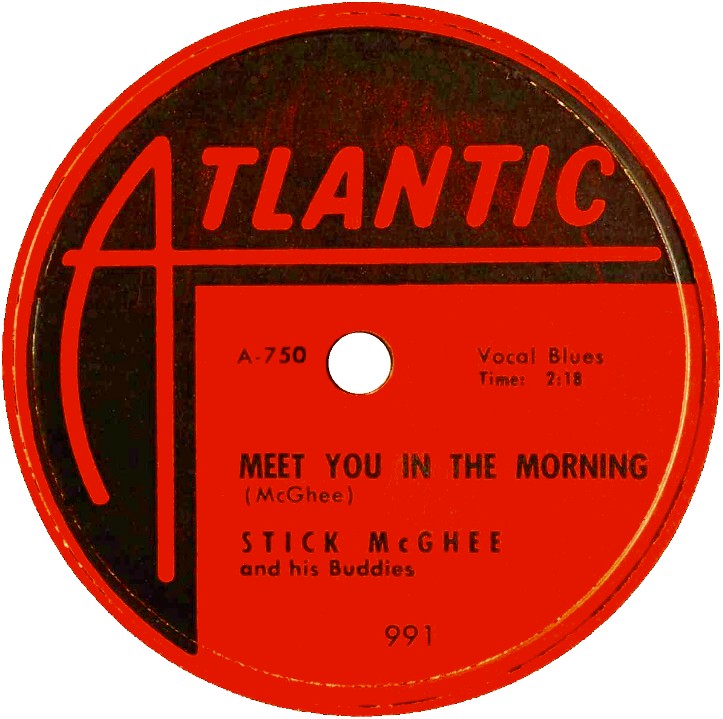
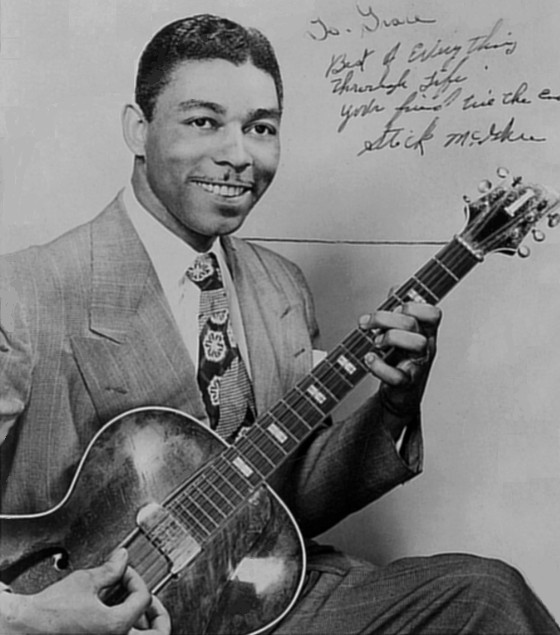
Brownie's brother Stick (aka "Sticks") McGhee, birth name Granville Henry McGhee, also had a version of "Meet You In The Morning", recorded in December 1951 and released on Atlantic Records #991 in 1953.Stick sings and plays guitar, while members of his "Buddies" (the band) vocally and instrumentally back him. Renowned Atlantic Records' pianist, Harry Van Walls, is one of the "Buddies", the others are unknown.
There are separate entries for this song at BMI.com, one credits "Granville McGhee" as the composer and the other, you guessed it.... "Robert Ellen" (Bobby Shad's pseudonym). There is also a third entry that credits "Walter B. McGhee", who is Brownie McGhee. The label gives one of the "McGhee"s a nod, most likely Stick.
|
|
The inscription on the above right photo is "To Grace Best of Everything Through Life. Your friend til the end. Stick McGhee". LISTEN (Windows Media Player): "Meet You In The Morning" - Stick McGhee And His Buddies - Atlantic 991 - 1953.
THE VOCALEERS
|
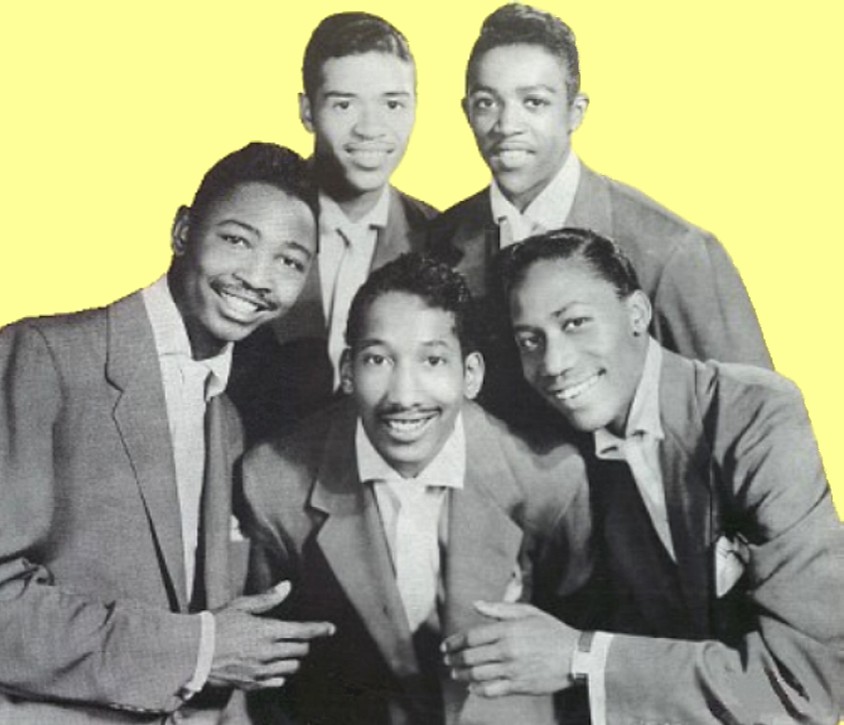
Above: A 1953 photo of The Vocaleers consisting of (Back L-R) William Walker (tenor), Herman Dunham (tenor), (Front L-R) Melvin Walton (baritone, tenor), Joe Duncan (lead tenor), and Lamar Cooper (bass). This is the line-up for their second release on Red Robin ("Is It A Dream"/"Hurry Home"). On their first record ("Be True"/"Oh! Where"), Teddy Williams sings bass instead of Cooper. Joe Duncan sings lead on all the ten sides released on Red Robin (1952-1954).
Click HERE for an article about The Vocaleers by Marv Goldberg. (Will open in a separate window)
|
|
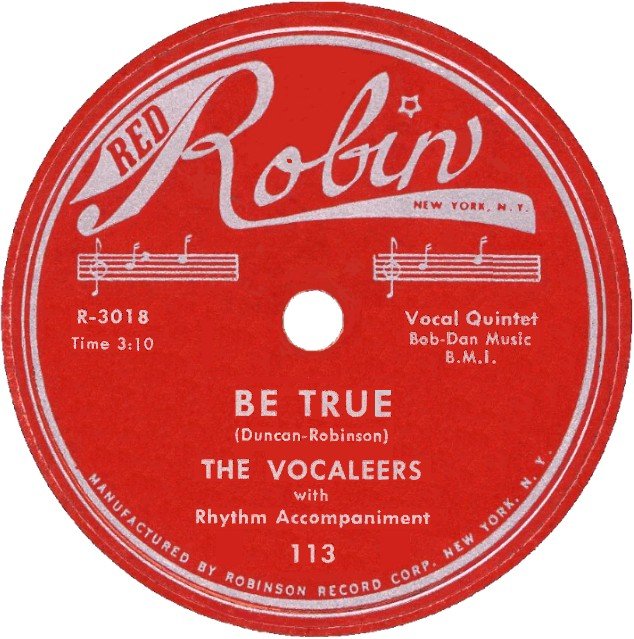
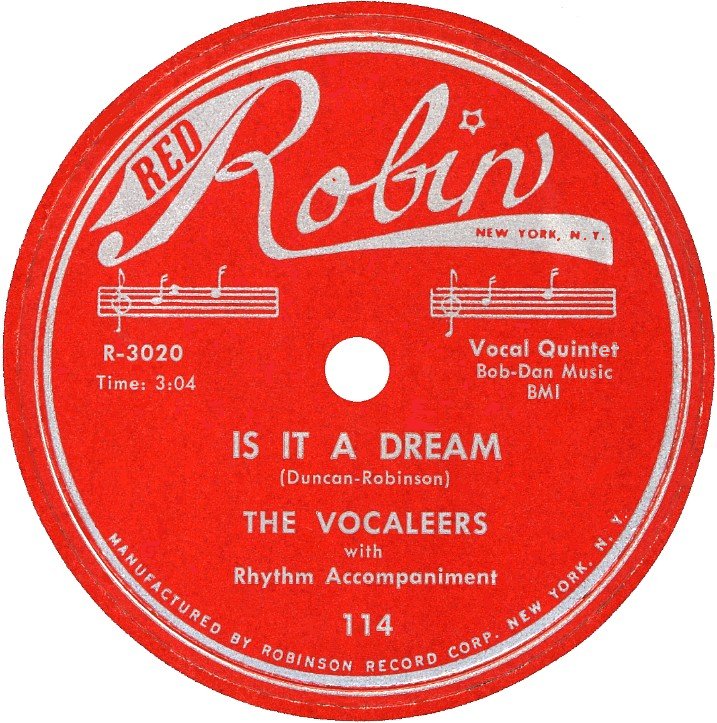
All four labels for the above two records credit "Duncan-Robinson" as the composers. "Be True" is the same at BMI.com. However, BMI.com gives only Bobby Robinson the rights to the other three titles. Did Joe Duncan, the group's leader, know this was happening? In fairness to Bobby, perhaps he was paying his artists for rights to the songs? OK, not likely you say? Agreed. Above Left: Label image of Red Robin 113, released in December 1952. This is the first record of five by The Vocaleers on Red Robin
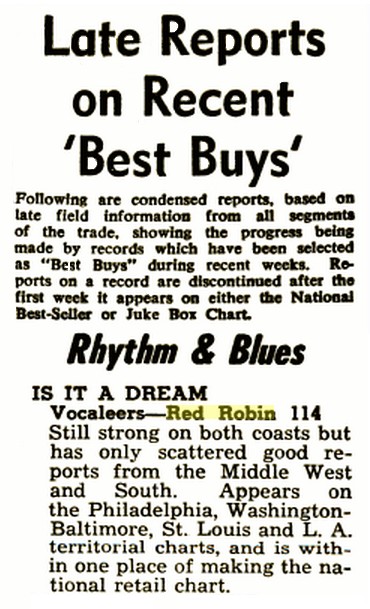
Above Right: Label image of Red Robin 114, released in March 1953. The Vocaleers, along with The Swallows on the King label, had a vocal group style and sound that was years ahead of its time.
CASH BOX, February 14, 1953:
....Robinson Record hit a big one in their "Be True" by The Vocaleers. Tune is on the Red Robin label and has broken in New York and Philly....Cash Box Review (2/14/53):
THE VOCALEERS — RED ROBIN 113
Oh! Where (B) A slow soft blues is simply and movingly presented by The Vocaleers.
Be True (B+) The Vocaleers etch a slow, melodic, and moody piece with romantic lyrics and come off with a top-flight deck. The group's relaxed and mellow presentation makes this a strong contender.(NOTE: A rating of B was considered as "very good" and B+ as "excellent".)
CASH BOX, June 27, 1953:
....Speaking of the "Hot Charts", the Vocaleers' Red Robin version of "Is It A Dream" is really zooming....LISTEN (Windows Media Player):
1. "Be True" - The Vocaleers - Red Robin 113 - 1952.
2. "Oh! Where" - The Vocaleers - Red Robin 113 - 1952.
3. "Is It A Dream" - The Vocaleers - Red Robin 114 - 1953.
4. "Hurry Home" - The Vocaleers - Red Robin 114 - 1953.BOTH SONGS played in sequence.
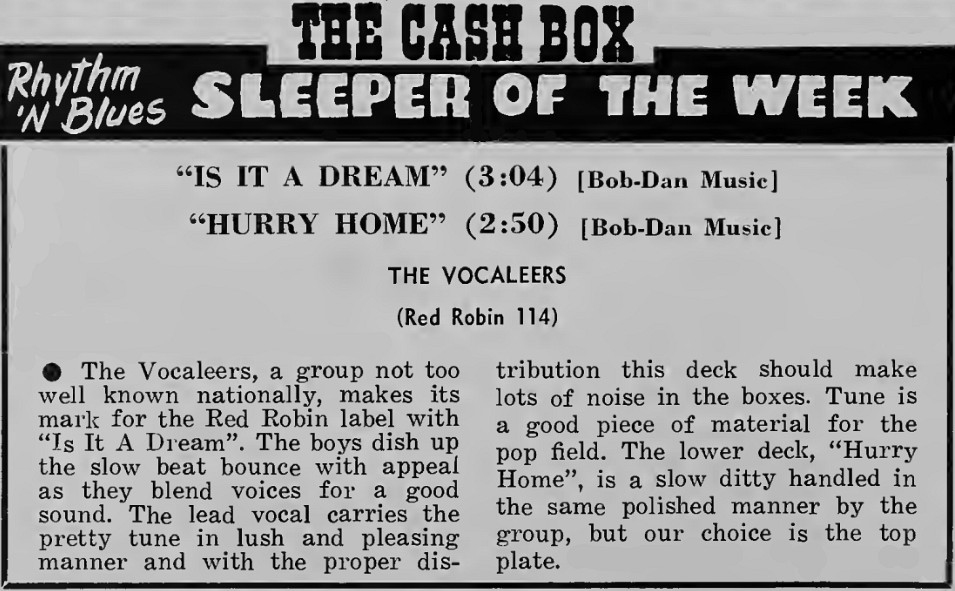
CASH BOX REVIEW — MAY 16, 1953.

|
|

|
Above: ATLANTA DAILY WORLD, July 26, 1953. [The Vocaleers - Joe Duncan, their lead singer, is at far right.]
THE CALL (Kansas City, Missouri), August 14, 1953:
NEWEST SINGING GROUP
The Vocaleers, (Red) Robin recording artists, are the newest group on the singing horizon, and they're great. The group, scoring rhythmically with hits "Oh! Where" and "Be True", have seemingly made juke box enthusiasts forget about a lot of other groups.That gives an indication of becoming tops on the Sepia Song Hit parade. These boys do a rhythm and blues vocalizing style that is really tops.
|
|
|
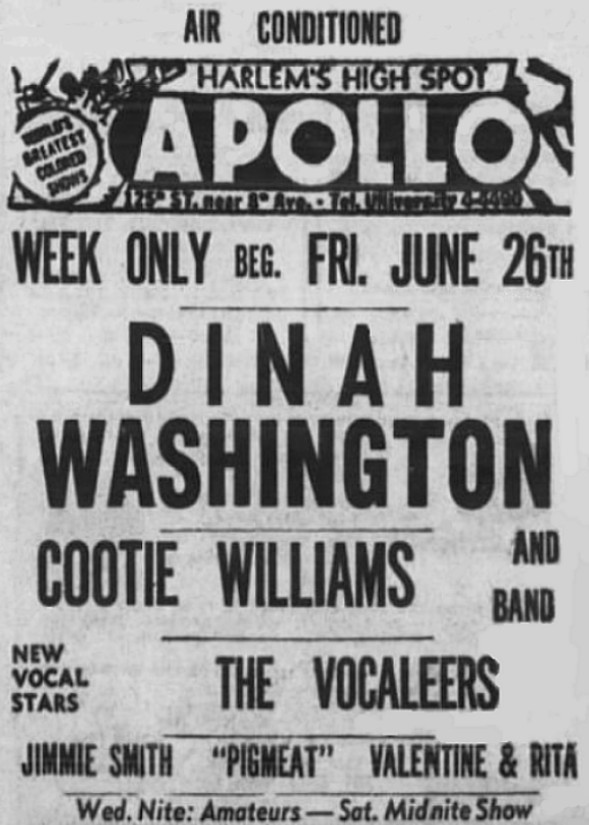
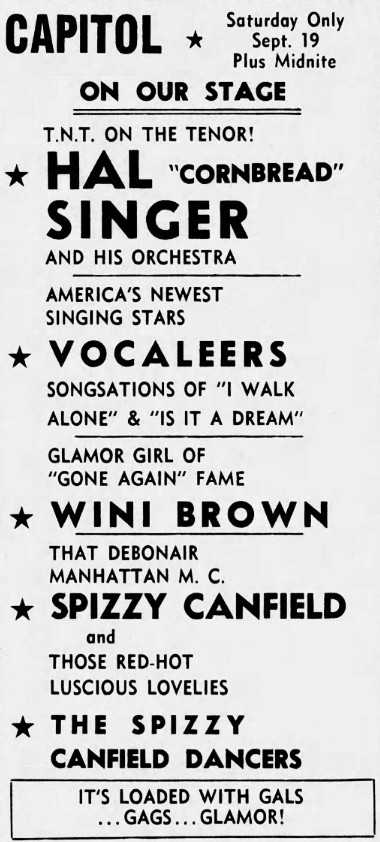
Above Left: NEW YORK AGE, June 1953. Above Middle: NEW JOURNAL AND GUIDE (Norfolk, Virginia), September 19, 1953.
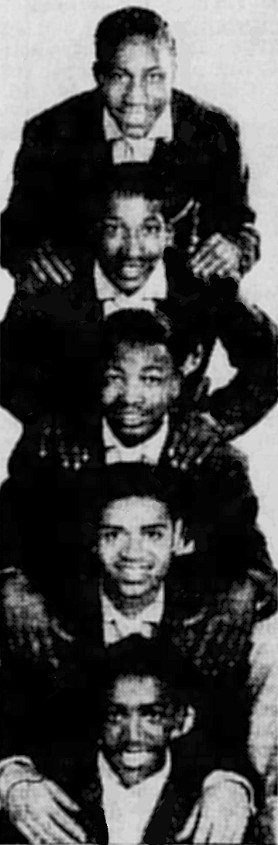
Above Right: NEW PITTSBURGH COURIER, November 11, 1953.
NOTE: (Top-Bottom) Lamar Cooper, Joe Duncan, Melvin Walton, William Walker, and Herman Dunham.

|

|

|
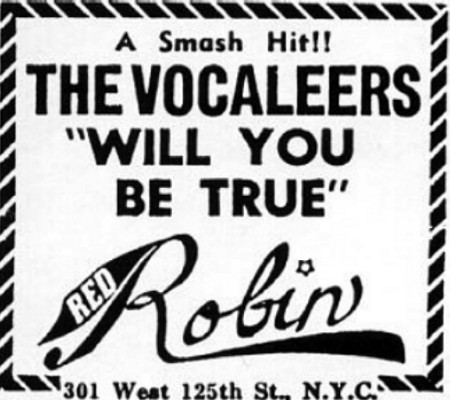
Above Left: Label image of Red Robin 125, released in January 1954. BMI.com credits Bobby Robinson and "Larry Dwain Robinson" for writing "Will You Be True". Could the latter name have actually been Danny Robinson? BMI.com also credits Larry Dwain with songs for The Velvets, The Scarlets, and The Rainbows that were released on Red Robin. Above Right: Label image of Red Robin 132, released in August 1954. This is the fifth, and last, record that The Vocaleers had on the Red Robin label.
No clue about "Crawford", shown on the label as composer, but Bobby Robinson alone takes the composer credit at BMI.com. The label for the flip-side, "Lovin' You", shows "Manning"... again no clue. However, BMI.com credits composers as Bobby and Larry Dwain, actually both names in two entries.
At Direct Right: CASH BOX, February 27, 1954.
CASH BOX, January 30, 1954:
..... Bobby Robinson again amazing with his uncanny knack of coming up with top groups. The Velvets with "I" are showing in the charts and The Vocaleers' new one, "Will You Be True," only out a week, is already showing strength. Robinson heads the Red Robin label....(NOTE: The Velvets will be included in Part Three of this article.)
The Billboard Review (2/13/54):
THE VOCALEERS — RED ROBIN 125
Will You Be True (84) The label, now riding with the Velvets, have another good group here. The Vocaleers turn in fine reading of a new ballad, selling it with smoothness and blend, helped no end by two sharp lead singers. This one could build into a real coin-grabber. Watch it.
Love You (75) Medium-tempo ballad is performed neatly by the Vocaleers, with the lead emoting while the boys sing close harmony behind him. Flip is a stronger side.(NOTE 21: Joe Duncan is the lead singer for "Will You Be True". Lamar Cooper, the bass singer, comes in for one stanza after the instrumental break.)
(NOTE 2: A ratings range of 70-79 was considered as "good" and 80-89 as "very good".)CASH BOX, March 13, 1954:
....Bobby Robinson of Red Robin Records tells us his 125th Street retail outlet showing stronger over the counter reaction and his national sales on the Vocaleers' "Will You Be True" moving potently....LISTEN (Windows Media Player):
1. "Will You Be True" - The Vocaleers - Red Robin 125 - 1954.
2. "Love You" - The Vocaleers - Red Robin 125 - 1954.
3. "Angel Face" - The Vocaleers - Red Robin 132 - 1954.
4. "Lovin' Baby" - The Vocaleers - Red Robin 132 - 1954.ALL FOUR SONGS played in sequence.


|
|
Above Left: AFRO-AMERICAN, November 7, 1953:
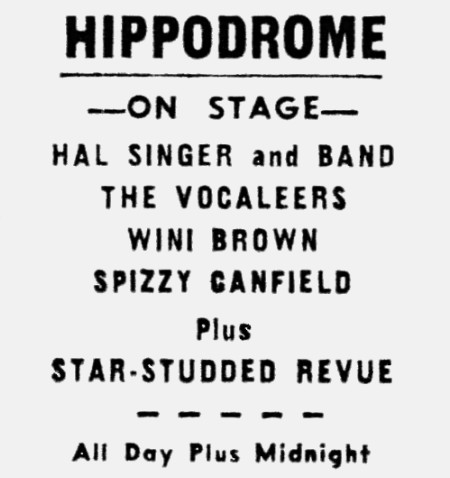
SONGSTERS — The Vocaleers are one of the big attractions in a package show now touring the country. This outfit is a swingy crew. Others in the show are Cootie Williams' ork, songstress Dolly Cooper, and several other acts.Above Right Top: CASH BOX, February 1954.
Above Right Bottom: RICHMOND TIMES DISPATCH, September 21, 1953.
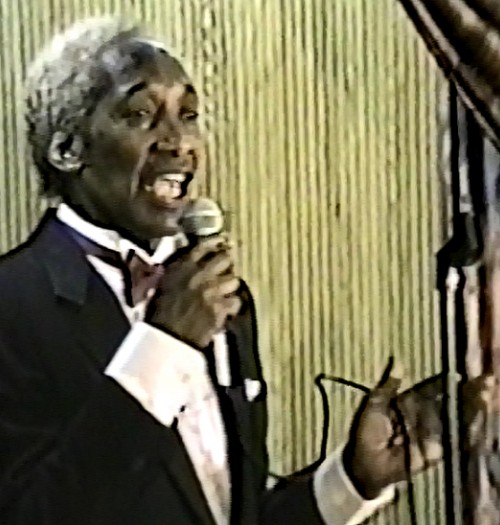
At Left: Joe Duncan singing with a "Vocaleers" group at UGHA on May 17, 1996:
LISTEN (Windows Media Player):
"Is It A Dream" - Joe Duncan And The Vocaleers - UGHA - 5-17-96.This audio is a quartet with Joe Duncan singing lead. I was in a front row seat for this performance. In an interview afterward, Joe said that his favorite lead singers had been Sonny Til and Clyde McPhatter. He also named "Love You" as his favorite Vocaleers' song.
The Vocaleers were inducted into the UGHA Hall Of Fame in 1996.
Below: Joe Duncan and a "Vocaleers" group at UGHA in June 1997.
Joe is at the far right. This is the same group that sang at UGHA in May 1996, except the singer at the far left was not present.
If anyone can identify the singers that are backing Joe in this photo, please let me know and I'll add their names here.

EXTRA RECORD — THE CRYSTALS AKA THE OPALS (ON THE LUNA LABEL)
There are three reasons that this record is included in The Vocaleers' section of this article: 1. The Crystals/Opals' sound is similar to that of The Vocaleers, especially the latter's "I Walk Alone".
Indeed, the "Come To Me Darling" lyrics include the words "I walk alone."2. Teddy Williams, the bass singer on The Vocaleers' first Red Robin release, is a group member on this record.
3. This is an excellent record all around, including the label colors and design!

|
|

|
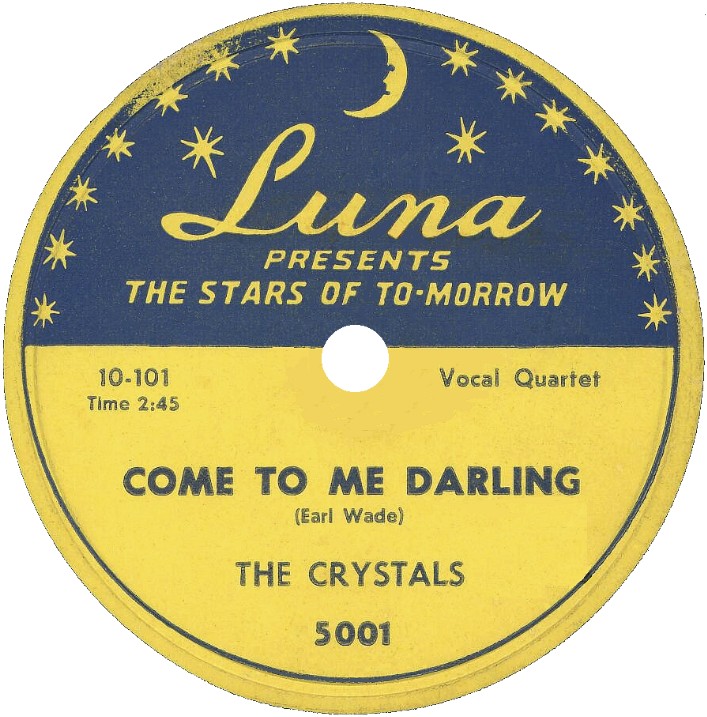
YOUR MISSION, should you choose to accept it, is to find eight differences between these two labels.............not!
Above: Label images of Luna 5001, one showing The Crystals and the other The Opals. Earl Wade composed the top side, while Buddy Cooper composed the flip-side, both credits agreeing with BMI.com.
The record was recorded in May 1954 and originally released that same month. In June, Luna, after becoming a subsidiary of Apollo Records, changed the label to "THE OPALS Formerly Known as THE CRYSTALS". This is because there already was a "Crystals" vocal group recording for DeLuxe Records.
The Opals had one more release, on Apollo, completing their short career. These were two more sides done at the first, and only, Luna recording session. See further below.
At Direct Right: The Crystals — The Opals
(Top L-R) Johnny Hopson (1st tenor), Earl Wade (baritone), (Bottom L-R) Teddy Williams (bass), and Martin Brown (2nd tenor).After The Opals broke up, Earl Wade joined The Cadillacs (1954-1959) and Teddy Williams went to The Four Fellows on Glory (1954-1957).
Cash Box Review (6/26/54):
THE CRYSTALS — LUNA 10-101
Squeeze Me Baby (B) The Crystals make their debut on the new label with a good wax. The boys drive along with a good beat and treatment of the bouncer. Material good but a little on the routine side.
Come to Me Darling (B) The Crystals perform a slow ballad prettily. The group has a good sound and performance promises well for the future.(NOTE: A rating of B was considered as "very good".)
The following review is another example that The Billboard generally
gave black vocal groups lower ratings than Cash Box did.The Billboard Review (6/26/54):
THE CRYSTALS — LUNA 10-101
Come to Me Darling (67) Mournful love ballad conveys a lonely mood with fair affect, the vocal quartet singing the lyrics ably.
Squeeze Me Baby (62) Routine rhythm opus is chanted in okay fashion by the group.(NOTE: A ratings range of 40-69, out of a 100 maximum, was considered as "satisfactory".)
CASH BOX, July 17, 1954:
....Apollo Records' Bess Berman's newest affiliation is Luna Records with "Squeeze Me Baby" and "Come To Me Darling" by the Crystals. The platter has already stirred up some noise in Baltimore and the West Coast. Ray Santos and Charles Lopez, who started Luna, are now affiliated with Apollo....TRADE MAGAZINE, August 1954:
....Luna Records, label distributed by Apollo here [New York City], hit the jackpot with its first release, "Come To Me Darling", an r.&b. item that was started on the road upwards with a big push by Jim Warren, Central Records, Los Angeles, where it first broke, and then by United Distributors in Chicago. The success has spread to Charlotte, Philadelphia, Pittsburgh and Newark....CASH BOX, September 4, 1954:
....The Opals on Luna with "Come To Me Darling" spreading through the country. New cities showing Opals action are Jacksonville, Fla., Charlotte, N.C., and St. Louis, Mo. Disk previously showed real strength in Los Angeles and Chicago....CASH BOX, September 25, 1954:
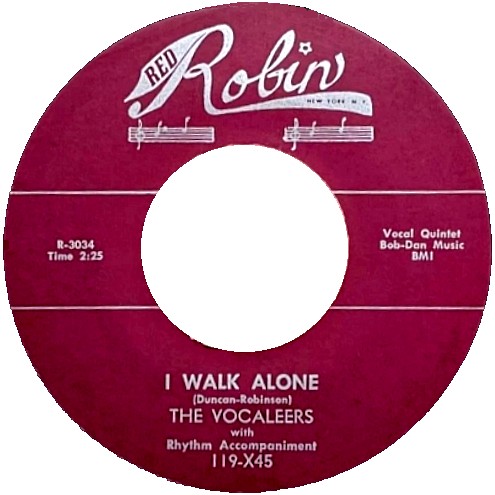
....Bess Berman, Apollo Records, busy getting out the orders on the Opals' "Come To Me Darling" on Luna....At Direct Right: Label image of Red Robin 119, released in 1953. Labels for both sides show "Duncan-Robinson" as composers, but BMI.com credits only Bobby Robinson.
LISTEN (Windows Media Player):
1. "Come to Me Darling" - The Opals (Crystals) - Luna 5001 - 1954.
2. "Squeeze Me Baby" - The Opals (Crystals) - Luna 5001 - 1954.
3. "I Walk Alone" - The Vocaleers - Red Robin 119 - 1953.
4. "How Soon" - The Vocaleers - Red Robin 119 - 1953.ALL FOUR SONGS played in sequence.

|

|
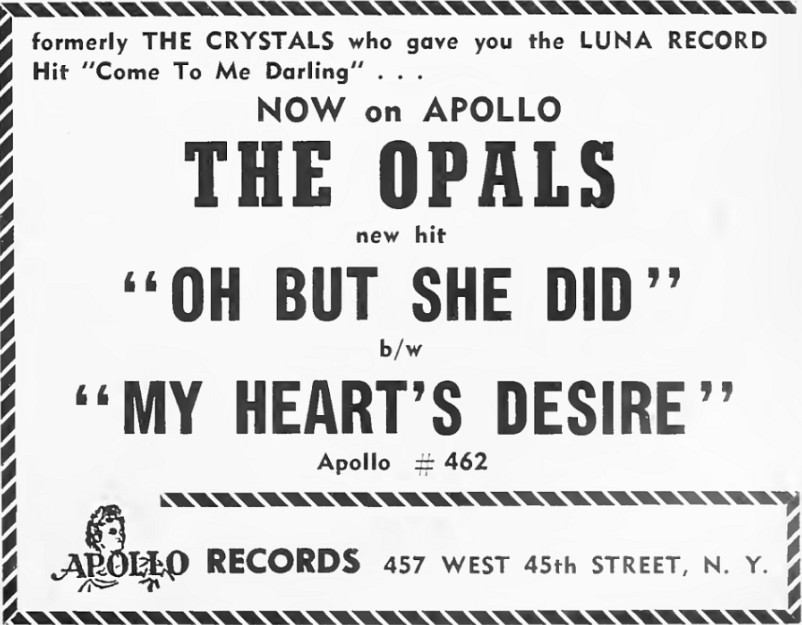
Above Left: CASH BOX, October 23, 1954. Above Right: Label image of Apollo 462, released in September 1954. All four sides released by The Crystals/Opals were recorded in the same May 13, 1954 session.
Top-side composer is Earl Wade, confirmed by BMI.com. Composers for the flip-side, "Oh But She Did", are "Milt Larkin-Bobby Smith", also confirmed at BMI.com. This song was also done by The El Capris on Bullseye 102 in 1956.
LISTEN (Windows Media Player):
1. "My Heart's Desire" - The Opals - Apollo 462 - 1954.
2. "Oh But She Did" - The Opals - Apollo 462 - 1954.BOTH SONGS played in sequence.
CASH BOX, October 2, 1954:
....Apollo released a new one by the Opals, whose "Come To Me Darling" on Luna was a solid hit. The Opals new issue, "Oh But She Did" and "My Heart's Desire", is on the Apollo label. Mrs. Berman also reports the signing of a new group which she guarantees will startle the country. "The group," she says, "from the name to the style is entirely different than anything we've yet heard."(NOTE: Might this group be The Upstarts, who had the one record on Apollo 468, "Feed Me Baby"/"Open The Door Baby"? Your thoughts?)
Cash Box Review (10/9/54):
THE OPALS — APOLLO 462
Oh But She Did (B+) The lads, formerly known as The Crystals on Luna, and whose "Come To Me Darling" is still selling big, come up with a middle tempo bouncer that looks like a strong follow up. Lyrics tell of how he has become disillusioned with his girl. Group can handle a tune and lyrics potently.
My Heart's Desire (B) The Opals melt a slow blues ballad sweetly. Strong coupling that could make noise.(NOTE: A rating of B was considered as "very good" and B+ as "excellent".)
THE SERENADERS
|
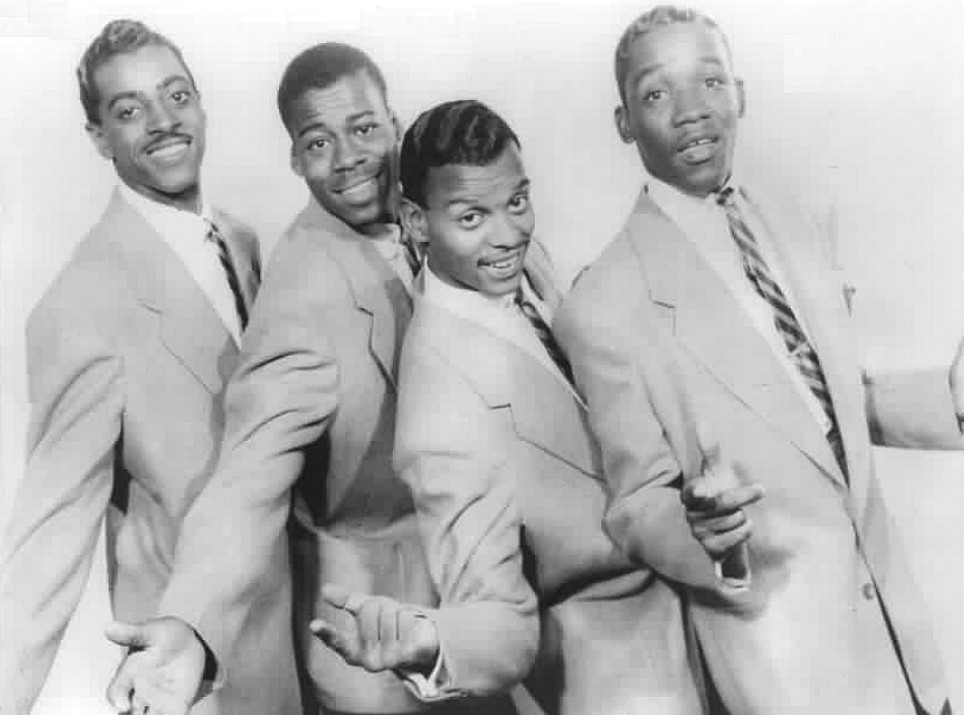
Above: 1954 photo of The Royal Jokers, from Detroit, Michigan, who were also known as The Serenaders, The Musketeers, and The Royals. In the photo are (L-R) Norman Thrasher, Ted Green, Thearon Hill, and Noah Howell. They had records on Roxy (1952), J-V-B (1952), Coral (1952), Swing Time (1953-1954), Red Robin (1953), DeLuxe (1953), Venus (1954), Atco (Atlantic subsidiary, 1955-1956), Hi-Q (Fortune subsidiary, 1957), and Fortune (1958).
Click HERE for an article about The Serenaders/Royal Jokers by Marv Goldberg. (Will open in a separate window)
|
|
EXTRA RECORDS — THE SERENADERS

|
Above: 1955 photo of The Royal Jokers, which was The Serenaders's name at the time.
In the photo, (L-R) Willie Jones (tenor), Norman Thrasher, Ted Green (bass), Thearon Hill, and Noah Howell.

|

|
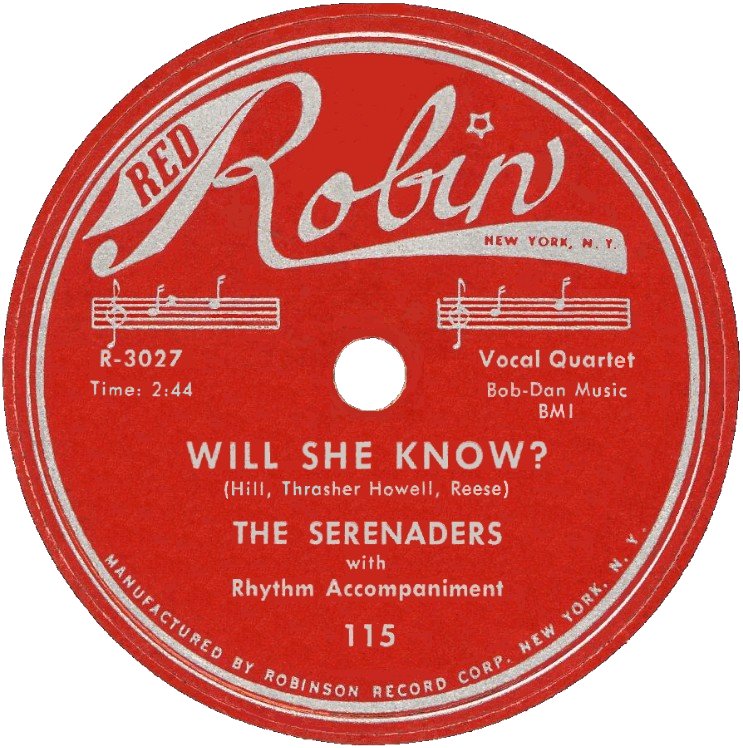
Above Left: Label image of Roxy 801 B, released in early 1952. The Musketeers were the same group as The Serenaders. This is their first record. These two songs, with "Goodbye My Love" renamed "Deep In My Heart" and the flip-side renamed "Love Me Til Your Dying Day", were reissued on Swing Time Records in 1953. "Musketeers" was misspelled "Muskateers" on the Swing Time labels.
Above Right: Label image of J.V.B. 2001-B, released in early 1952. Both Roxy and J.V.B. were Detroit labels; The Musketeers/Serenaders were from Detroit.
"Tomorrow Night" was a #1 rhythm and blues hit for Lonnie Johnson on King Records in 1948, described on the label as "Lonnie Johnson's Theme Song".
Indeed, Lonnie had originally released the song on Paradise Records in December 1947, possibly the first record on Paradise. The label misspelled the composer's name, Will Grosz, as "Wm Gross". Grosz also was co-composer of the 1954 song, "Isle Of Capri", by The Gaylords.
For my money, the best version of "Tomorrow Night" was done by LaVern Baker And The Gliders, released on the Atlantic label in 1954. If you like rhythm and blues with deep feeling, give this one a listen. It was unfortunately overshadowed as the flip-side of LaVern's big hit, "Tweedle Dee".
For both of the above Musketeers/Serenaders' records, Disco-File gives the members as Thearon Hill, Noah Howell, Norman Thrasher, and Isaac Reese.
At Direct Right: ATLANTA DAILY WORLD, June 3, 1955.
NOTE 1: From The Billboard (3/26/55)....The Royal Jokers, Detroit vocal group co-managed by Al (Flame Show Bar) Green and Chuck Darwin, have signed with the Gale Agency...
NOTE 2: The group did not change their name again after recording for Atco Records as The Royal Jokers.At Far Right: NEW YORK AGE, September 1955.
LISTEN (Windows Media Player):
1. "Goodbye My Love" - The Musketeers - Roxy 801 B - 1952.
2. "Love Me Till My Dying Day" - The Musketeers - Roxy 801 A - 1952.
3. "Tomorrow Night" - The Serenaders - J.V.B. 2001-B - 1952.
4. "Why Don't You Do Right" - The Serenaders - J.V.B. 2001-A - 1952.ALL FOUR SONGS played in sequence.
|
|
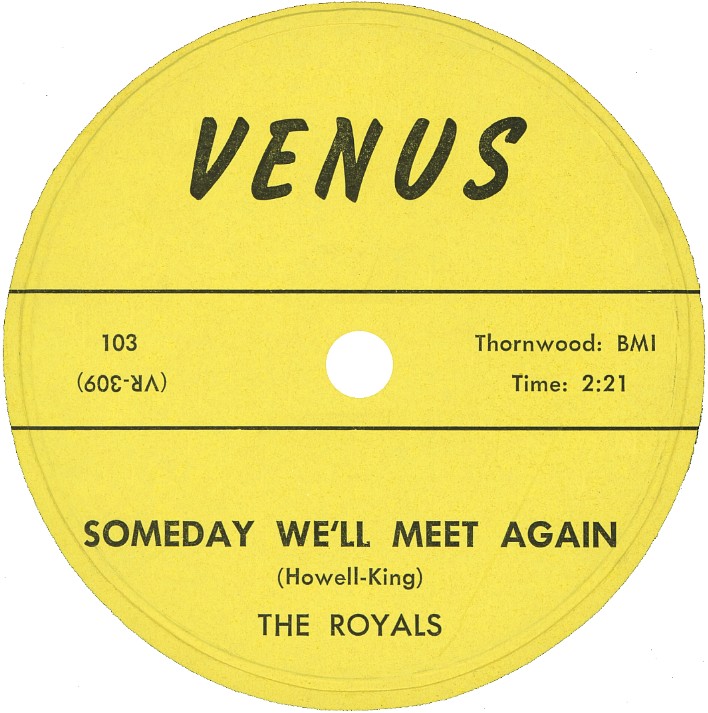
Above Left: Label image of Venus 103, a small Detroit company, released in October 1954. This is The Royals' only record on the Venus label and the only time The Serenaders used The Royals name. Thearon Hill sings lead on "Someday We'll Meet Again". Noah Howell, a member of The Royals, and Maurice King are shown as composers on both sides. Maurice King and his Wolverines were a Detroit band that had releases on Columbia/Okeh in the early 1950's, including backing up Bea Baker (LaVern Baker) on some of them.
Maurice also operated a booking office in Detroit, the "Wolverine Theatrical Agency". Do not know if it's his band on Venus 103.
Disco-File gives the members of The Royals on Venus as Thearon Hill, Noah Howell, Norman Thrasher, and Isaac Reese.
This is a vinyl 78-rpm record. The matrix number is shown upside down on both sides, and is also shown that way on the 45-rpm record. The song title on the flip side, "I Want You To Be My Baby", is followed by " - Mambo".
LISTEN (Windows Media Player):
1. "Someday We'll Meet Again" - The Royals - Venus103 - 1954.
2. "I Want You To Be My Baby" - The Royals - Venus103 - 1954.BOTH SONGS played in sequence.
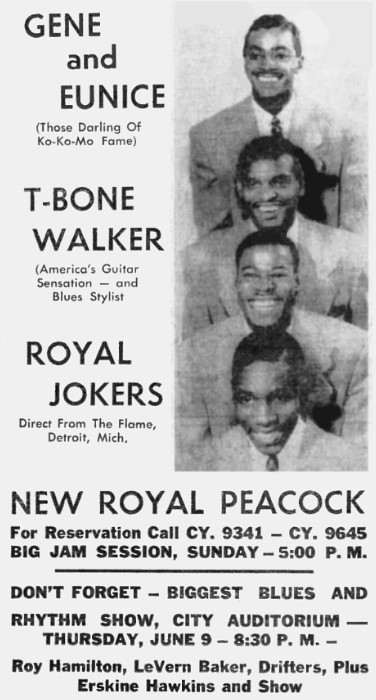
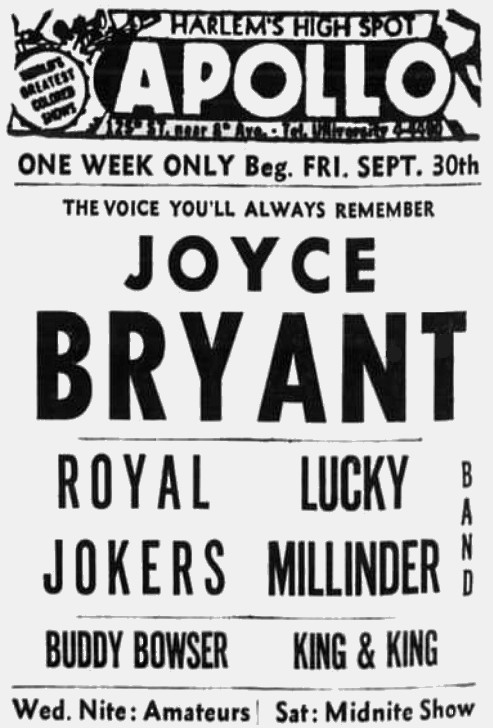
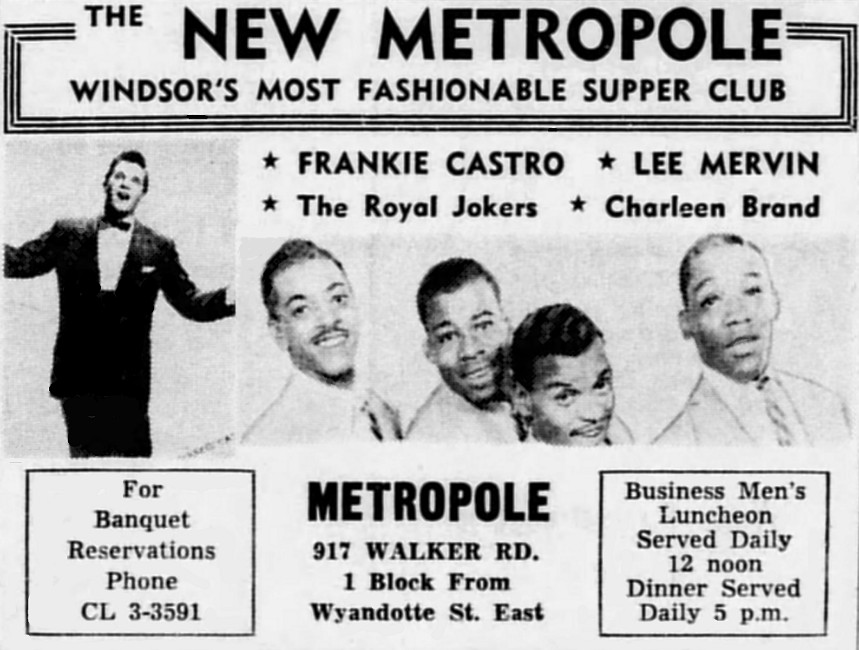
Above Right: WINDSOR STAR (Windsor, Ontario, Canada), December 8, 1954.
NOTE: The Royal Jokers (L-R) Norman Thrasher, Ted Green, Thearon Hill, and Noah Howell.The Billboard Review (6/13/54):
THE ROYAL JOKERS — VENUS 103
Someday We'll Meet Again (76) Sincere vocal treatment of a plaintive weeper, with effective lead warbling, Good juke programing.
I Want You To Be My Baby (69) A comparatively mild mambo warbled pleasantly by the boys. However, flip is better showcase for group.(NOTE 1: A ratings range of 40-69 was considered as "satisfactory" and 70-79 as "good".)
(Note 2: Billboard credited "The Royal Jokers," not "The Royals". How did the reviewer know that? The group did not have a record using the name "Royal Jokers" until almost a year later. Also see the following newspaper blurb.)
LOUISVILLE DEFENDER, November 11, 1954:
MORE ROYALS — The Royals, the latest group by that name who have been recording for Venus Records, have changed their name to The Royal Jokers. The group is managed by Chuck Darwin.
|
 |
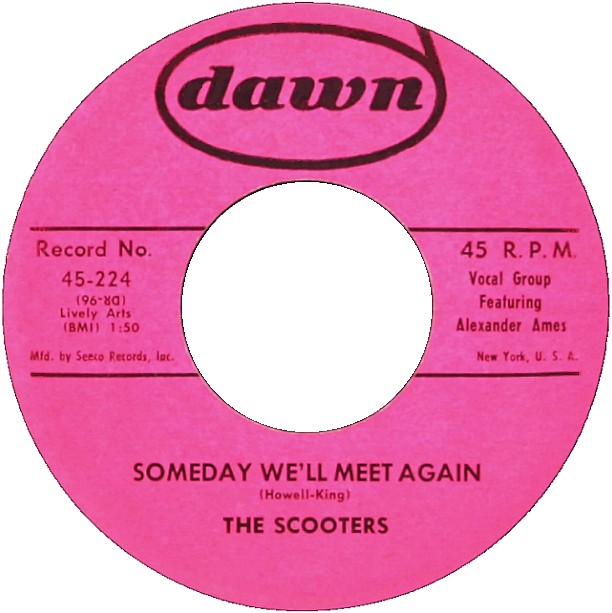
Above Left: Label image of Dawn 224, released in January 1957. "Alexander Ames And The Scooters" is a ficticious name for the real singers, Thearon Hill And The Royals. The flip-side is not The Scooters or The Royals. Notice the upside down matrix number (DR-96) on the label. A tribute to Venus Records and their upside down matrix number (VR-309)? Chuck Darwin, who reportedly had managed The Royals, was the A&R man for Dawn Records at the time of this release. It's likely that Chuck was involved in producing this record.
The Dawn record may not be the same take as that used for the Venus record. There are definite differences. Audio is provided at right. Your thoughts, please.
Above Right: THE BILLBOARD, February 16, 1957.
At Direct Right: CASH BOX, January 23, 1954.
NOTE: Vocal groups with records on the Dawn label include The Bards (1954), The Starlings (1955), and The Sophomores (1956-1958).The Billboard Review (2/16/57):
THE SCOOTERS — DAWN 224
Someday We'll Meet Again (80) This boys' group has a high-voiced lead who really wails on this teary-eyed ballad. His voice has a cutting edge that can't fail to perk up listeners' ears. Material also impresses as commercially potent.(NOTE: A ratings range of 80-89 was considered as "excellent".)
LISTEN (Windows Media Player):
"Someday We'll Meet Again" - The Scooters - Dawn 224 - 1957.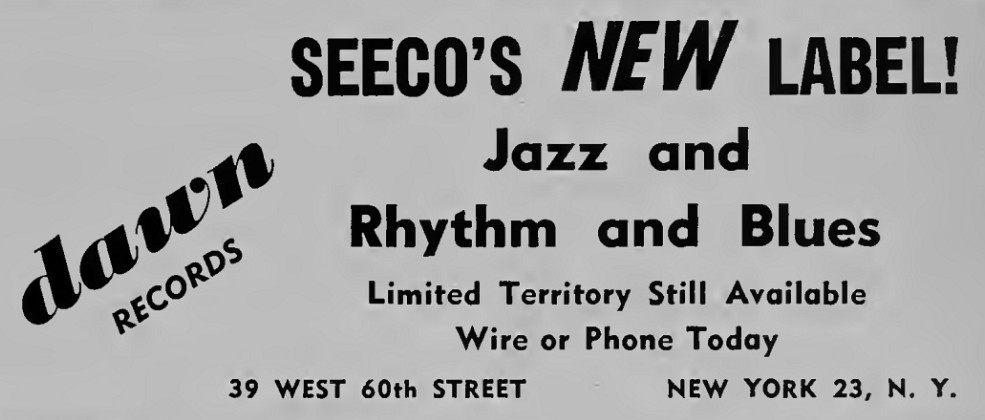
LIVE PERFORMANCE — "SOMEDAY WE'LL MEET AGAIN" — THEARON HILL AND "THE ROYALS"

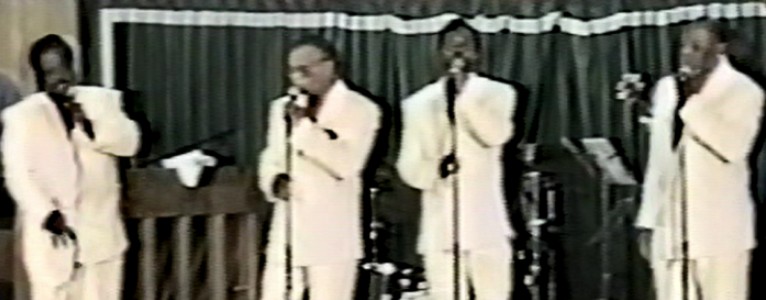
Photo At Left: Thearon Hill singing lead on "Someday We'll Meet Again" with a "Royals" group (Above Photo), which included Willie Jones. This was at Ronnie I's UGHA Collectors Groups Concert on May 17, 1996 in New Jersey.The Serenaders/Royals/Royal Jokers performed for 40 minutes, took a break, and then came back to sing another four songs, ending with "Someday We'll Meet Again." This was followed by a 20 minute question and answer session with the audience. Fortunately, I had a front row seat for all of it.
LISTEN (Windows Media Player): "Someday We'll Meet Again" - Thearon Hill And The Royals - UGHA - May 17, 1996.
NOTE: Restoration of photos, clippings, record label images, and audio is by Tony Fournier.
RED ROBIN RECORDS - PART ONE FEATURES SPOTLIGHTS ON BOBBY ROBINSON AND JOEL TURNERO. ALSO INCLUDED ARE MORRIS LANE AND BAND, CHARLIE SINGLETON AND HIS ORCHESTRA, VOCALIST FREDDIE JACKSON, THE MELLO-MOODS, THE SWALLOWS, THE VIBES, TWO GOSPEL KEYS, RED PRYSOCK AND HIS HOUSE ROCKERS, THE DU-DROPPERS, AND THE EMBERS.
1. "Number Nine Blues" - Champion Jack Dupree - Red Robin 109 - 1952.
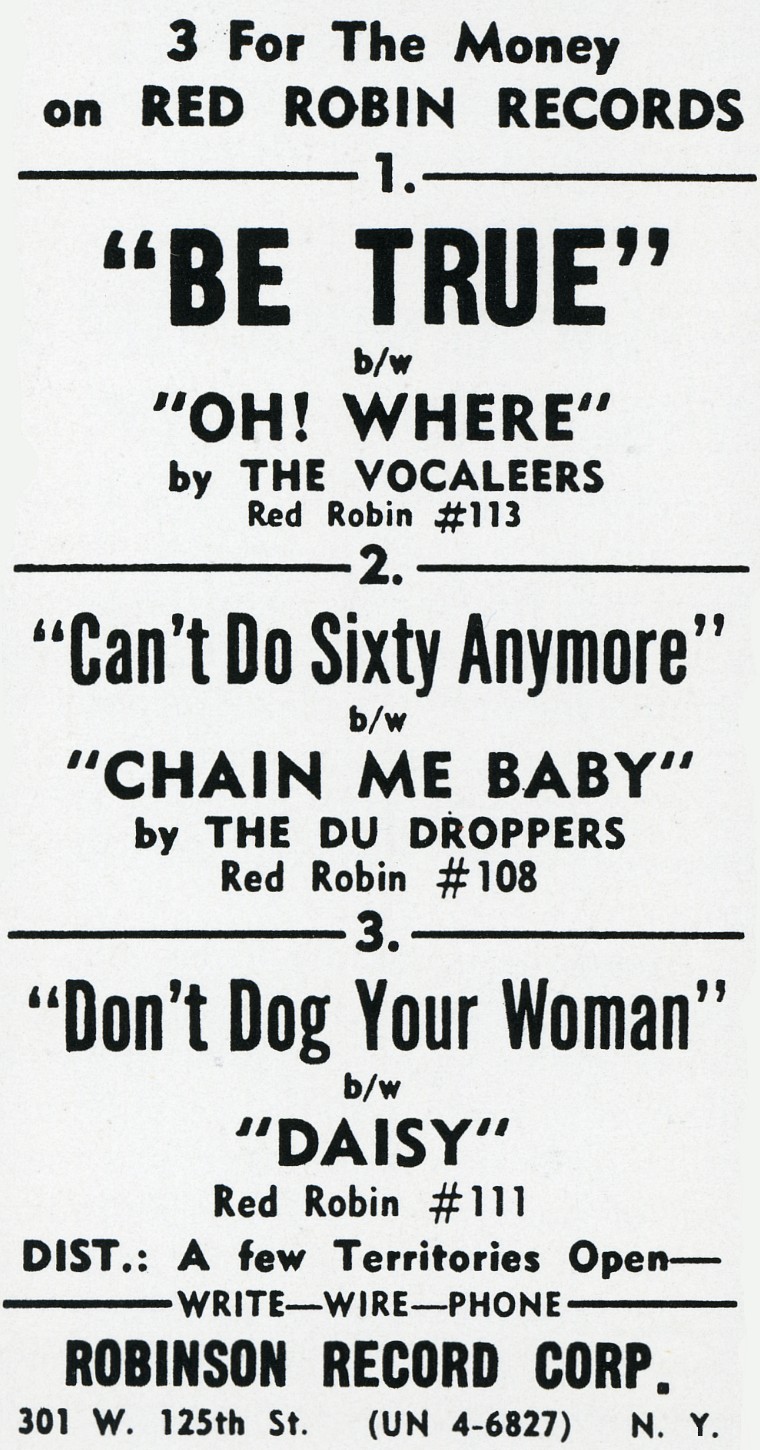
ALL TWENTY-TWO ABOVE RED ROBIN LABEL SONGS played in sequence. At Right: CASH BOX, February 7, 1953.
|
|
Last Update: April 10, 2026
E-mail Me: