
|
#964 (1/5/25)
|
|
|
BY TONY FOURNIER |
INSTRUMENTAL RECORDS Some of the orchestras to record instrumental records for King Records were Earl Bostic, Todd Rhodes, Russell Jacquet, Tab Smith, King Porter, Moose Jackson, Joe Thomas, Tiny Bradshaw, Sonny Thompson, Mary Lou Williams, Wild Bill Moore...
...Lucky Millinder, Erroll Garner, Al Sears, Erskine Hawkins, Bill Doggett, Jimmy Cole, Hot Lips Page, Sticks McGhee, Charlie Brantley, Duke Hampton, Earl Hines, Anna Mae Winburn, Bill Jennings, Rufus Gore, Doc Bagby, Big John Greer, Cozy Cole, and Gene Redd.
AL SEARS AND HIS ORCHESTRA

|
|
(BULL) MOOSE JACKSON

|
|

|

|

|

|

|
Above Left: ATLANTA DAILY WORLD, August 15, 1948. Above Middle: THE STATE, July 5, 1948.
Above Right: EVENING STAR, July 15, 1948.
BILL DOGGETT

|
Above: CASH BOX COVER, November 24, 1956.
CASH BOX COVER CAPTION:
Since Bill Doggett’s smash version of "Honky Took" on the King label has part one on the first side and part two on the other, King officials considered it only right that he receive two gold records, one for each part, on his million selling disk.Pictured left to right are: Bill Doggett, who plays the organ; Clifford Scott, tenor sax; Billy Butler, guitar; Shep Shepherd, drums; and Syd Nathan, president of King Records.
In addition to "Honky Tonk", which remains high on all the charts, Doggett has just released a recording of "Slow Walk".

|
|
|

|

|

|

|

|
JOE THOMAS
|
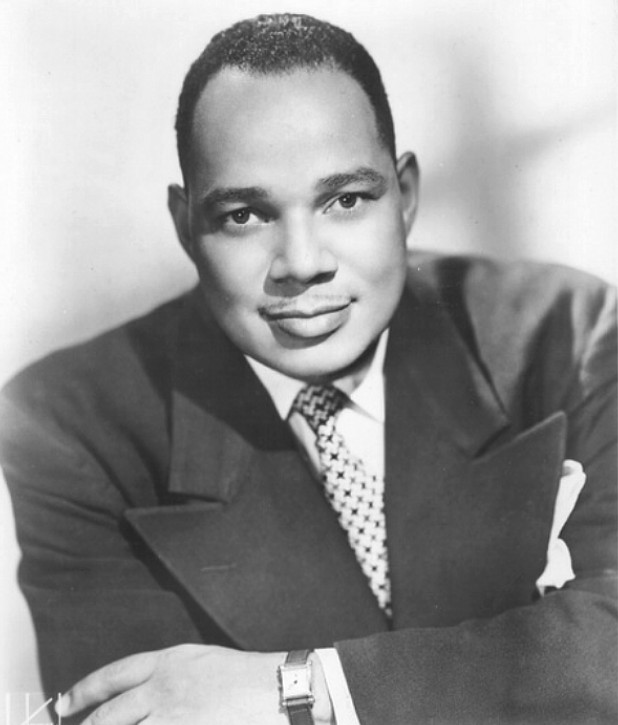
Above: Joe Thomas, from Pennsylvania, was a saxophonist, singer, songwriter, arranger, and bandleader.
Joe played tenor saxophone in Jimmie Lunceford's orchestra from 1933 until Lunceford died in 1947. Joe and Eddie Wilcox, the band's piano player, took over leadership of Lunceford's orchestra until 1949, when Joe obtained his own band (formerly Oliver Hill's orchestra).
Joe and this band had six recording sessions for King Records from 1949 to 1951, resulting in eleven records by them. He then retired from the music industry.
Much more coverage of Joe Thomas is in the King Records - Part Three article.
Extensive coverage of Jimmie Lunceford is available in a two-part article.
|
|

|
|
SPIRITUAL RECORDS Some of the spiritual groups to record for King Records were Paul Breckenridge And His Four Heavenly Knights, Swan's Silvertone Singers, Wings Over Jordan, Southern Harps, Lee Roy Abernathy And His Quartet, Harmoneers...
Jewel Jubilee Singers, Jubalaires, Blue Jay Singers, Spirit Of Memphis, Nightingales, Trumpeteers, Flying Clouds Of Detroit, Wright Family Singers, Swanee River Boys, and Little Jimmy Scott And His Group.
PAUL BRECKENRIDGE AND THE FOUR HEAVENLY KNIGHTS

|
Above: Photo of Paul Breckenridge, who was a lead tenor for both spiritual and popular songs. He could hit the high notes with the best of them and hold them as long.
At Direct Right: NEW YORK AGE, September 4, 1948.
NOTE: There is extensive coverage of Lucky Millinder on the King label in the King Records - Part One article.At Far Right: KNOXVILLE JOURNAL, May 8, 1949.
Paul Breckenridge, nick-named the "Harlem Hurricane", was actually from Cleveland. A member of the Gethsemane Baptist Church, he was the youngest of seven brothers. Paul graduated from East Technical High School in Cleveland and soon after joined the Wings Over Jordan. In 1942, at the age of 21, he was one of the stars of the ensemble, his "clear falsetto tones holding the audience spellbound."
In 1946, Lucky Millinder "discovered" Paul as a "new singing sensation," becoming one of Lucky's featured singers on stage and records. In 1948, Paul, along with Lucky, starred in the full-length movie "Boarding House Blues". At the same time, they had a regular Wednesday night radio show, "Swingtime At The Savoy", on the NBC coast-to-coast network. And were also appearing at the Apollo Theatre and the "famed" 845 Club, both in New York City.
Paul's first popular recording (with Lucky) is "You Can't Put Out The Fire". While still with Lucky, Paul had four spiritual records released on King, backed by the Four Heavenly Knights (1947-1948).
In early 1949, Paul dissolved his contract with Lucky, just after "Journey's End", a spiritual song, was released on RCA Victor. He returned to the Church and his chosen calling, religious singing, much in the manner that Sister Rosetta Tharpe had left Lucky earlier. Shortly after, Paul began his renewed undertaking with a series of religious concerts in the South and Southwest.
Then, in 1951, Paul came back to the popular singing world. The 11/3/51 Pittsburgh Courier states that "Paul Breckenridge is getting set for a recording session while drawing rave reviews for his vocalizing at the Majestic Rose Room, where he is featured with Duke Jenkins' band..."
A July 7, 1959 clipping in the Ottawa Journal shows "Paul Breckenridge, Recording Star" appearing nightly at the Cameo Lounge And Rainbow Room, at the Standishall. And, in 1968, we find "Paul Breckenridge, The Man With The Golden Voice" at the Metropole in Montreal.


KINGSPORT NEWS — NOVEMBER 4, 1943 
KNOXVILLE NEWS SENTINEL — MARCH 3, 1946

|
PITTSBURGH COURIER, April 5, 1947:
LUCKY SAYS BRECKENRIDGE GREATEST OF NEW SINGERS
NEW YORK—Lucky Millinder, the dynamaestro of swing, is around the Broadway music marts challenging the entire industry to match his latest singing find, Paul Breckenridge.Believe it or not, the challenge finds no takers because the acrobatic batoneer has him an unmatched record of bell ringing discoveries.
(NOTE: Among Lucky Millinder's other "discoveries" are Trevor Bacon, Sister Rosetta Tharpe, Annisteen Allen, Judy Carol, Wynonie Harris, Big John Greer, Bull Moose Jackson, and Sarah McLawler. Also, Ruth Brown, prior to her Atlantic days, was Millinder's "featured vocalist" for one appearance before he rudely fired her.)
PITTSBURGH COURIER, March 22, 1947 (Carnegie Music Hall Concert Review): ....Paul Breckenridge, a tenor find now singing with Lucky Millinder's Orchestra, sang "Lonesome Road" in an interesting high register tenor that caught the favor of the audience....

|

|
Above Left: Label image of King 4182, recorded in August 1947 and released in October 1947. Paul exhibits his high tenor skills, especially on the flip-side, "Rock-A-Ma-Soul". The Four Heavenly Knights consisted of Thomas Delaney (tenor), Kelly Williams (tenor), Anderson Shaw (baritone), and Thomas Hines (bass).
Above Right: Label image of King 4192, also recorded in August 1947 and released in late 1947. "I Shall Not Be Moved" picks up its tempo about fifty seconds in, continuing on with Paul's high tenor gymnastics!
The above two records were Paul Breckenridge And The Four Heavenly Knights' first and second releases of four on the King label.
At Direct Right: THE CALL (Kansas City, Missouri), September 16, 1949:
MILLINDER'S STAR SOLOIST — Paul Breckenridge, Lucky Millinder's Golden Voiced singer, is rapidly becoming the nation's favored male singer. Formerly a first tenor with the Wings Over Jordan choir, Breckenridge brings to the dance bandstand a refreshing interlude in the terrific swing of the Millinder band.His rendition of tunes such as "Trees" and "Because" draw down the howling applause of patrons who come primarily for nothing but the hottest kind of swing. Possessing a wide range and beautiful tones, Breckenridge is certain to please.
The Billboard Review (12/13/47):
PAUL BRECKENRIDGE (FOUR HEAVENLY KNIGHTS) - KING 4182....
Rock-A-Ma-Soul (66) This rhythmic spiritual moves at a satisfactory pace.
Lonesome Road (76) Good treatment with Breckenridge in fine voice.(NOTE: A ratings range of 40-69 was considered "satisfactory" and 70-79 was "good.")
The Billboard Review (4/24/48):
PAUL BRECKENRIDGE AND HIS FOUR HEAVENLY KNIGHTS — KING 4192....
I Shall Not Be Moved (70) Restrained and moving first chorus piping by Breckenridge leads way to rhythmic group chanting.
Shine On Me (69) S1ow, sincere harmonizing by Breckenridge and the Knights on a meditative spiritual.LISTEN (Windows Media Player):
1. "Rock-A-Ma-Soul" - Paul Breckenridge And The Four Heavenly Knights - King 4182-A - 1947.
2. "Lonesome Road" - Paul Breckenridge And The Four Heavenly Knights - King 4182-B - 1947.
3. "I Shall Not Be Moved" - Paul Breckenridge And His Four Heavenly Knights - King 4192-A - 1947.
4. "Shine On Me" - Paul Breckenridge And His Four Heavenly Knights - King 4192-B - 1947.ALL FOUR SONGS played in sequence.


|

|
Above Left: Label image of King 4258, both sides recorded in September 1947 and the record released in November 1948. on the "Staff In My Hand" side, the tamborine is by Deacon Shoestring. This is the fourth, and last, spiritual record by Paul Breckenridge on the King label. Seven of the eight sides are traditional spiritual songs. The labels on both sides show the arrangements are by Lucky Millinder. Lucky also co-composed the non-traditional side, "Merry Christmas (To You)", with Henry Glover.
Above Right: Photo of Paul Breckenridge when he was the featured singer with Lucky Millinder's orchestra.
LISTEN (Windows Media Player):
1. "Staff In My Hand " - Paul Breckenridge And The Four Heavenly Knights - King 4258-A - 1948.
2. "Nobody Knows The Trouble I've Seen" - Paul Breckenridge And The Four Heavenly Knights (No Vocal Group Backing) - King 4258-B - 1948.BOTH SONGS played in sequence.

|
Above: Photo of (L-R) Paul Breckenridge, Mary Lou Williams, and Bill "Hawk" Hawkins, who was Cleveland's first black R&B disk jockey. Around the time of this photo, there was also a white R&B disk jockey in Cleveland. Learn more about him in the Alan Freed Newsprint articles.

|
Above: Photo of (L-R) Mary Lou Williams, Bill "Hawk" Hawkins, and Paul Breckenridge. Hawk was at WDOK in Cleveland at this time, which must have been in the early 1950s. WDOK radio began operation in April 1950. "WEWS" (Channel 5) was Cleveland's first TV station.
TEMPORARY DIGRESSION — MARY LOU WILLIAMS

|
Above: Photo of Mary Lou Williams, who was a pianist, arranger, composer, and orchestra leader. She famously composed the song "Satchel Mouth Baby" (aka "Pretty Eyed Baby") and in March 1944 was the first to record it.
Mary Lou had four records released on the King label (1949-1950). There were two Extended Play 45-rpm records made from her eight released songs.
Above Left: Label image of King 15003-A, recorded in March 1949 and released in 1949. The flip-side, "Knowledge", is an instrumental. King Records introduced its "Popular" 15000 Series in 1949. Personnel on this side are Mary Lou Williams (piano), Kenny Hagood (Vocal), Allen Feldman (flute), Idrees Sulieman (trumpet), Martin Glaser (bass clarinet), Mundell Lowe (guitar), George Duvivier (bass fiddle), and Denzil Best (drums).
Above Right: THE BILLBOARD, April 23, 1949:
At Direct Right: Pancho Kenny Hagood, the vocalist on the above side.
The Billboard Review (5/7/49):
MARY LOU WILLIAMS - KING 15003....
OO-BLA-DEE (75) Pancho Hagood sings what is probably the first true bop ballad on wax. It's actually a lovely, fragile piece that tells an amusing story. Warbler does great by the music, as does the smart ork group.(NOTE: A ratings range of 70-79 was considered as "good".)
LISTEN (Windows Media Player):
"OO-BLA-DEE" - Mary Lou Williams (Vocal By Pancho Hagood) - King 15003-A - 1949.

|

|
BACK TO SPIRITUAL RECORDS
WRIGHT FAMILY SINGERS The Wright Family Singers, who were from Dayton, Ohio, formed in 1945. They made appearances on the Arthur Godfrey talent show in 1947. The group stayed together, singing on WLW-D television until 1953.
Three of the young women who had been in the Wright Family Singers, Eleanor, Ruby, and Audrey Wright, formed their own trio, the Blend-Wrights.

|

LISTEN (Windows Media Player):
1. "Go Where I Send Thee" - Wright Family Singers - King 4481-A - 1951.
2. "It Is No Secret" - Wright Family Singers - King 4481-A - 1951.BOTH SONGS played in sequence.
At Left: Label image of King 4481, recorded in July 1951 and released that same month. At Right: Eleanor Wright.
The Wright Family Singers had two records released on the King Label, both in 1951. All four sides were recorded in the same July 7, 1951 session.
The composer of "Go Where I Send You" is Eleanor Adella Wright, who was a member of the Wright Family Singers. She is credited with 54 work titles at BMI.com.
DAYTON DAILY NEWS, July 29, 1951:
....And a group that can't miss is Dayton's Wright Family Singers. Their first record is now on the market for King, pairing "It Is No Secret" with an original spiritual written by Eleanor Wright, "Go Where I Send Thee".The second side has some moving moments, paced by Eleanor's obbligatto, but Secret is a better indication of what the group can do. Two good sides....
DAYTON DAILY NEWS, August 12, 1951:
....The Wright Family Singers, from Dayton, will cut some more sides for King Records in a recording session at Cincinnati early this week. Their first record, matching "It Is No Secret" and "Go Where I Send Thee", is going fairly well, recently showing signs of hitting in Philadelphia.Next side will be "Peace In The Valley". They may cut some sides with male quartet, Spirit Of Memphis group....
(NOTE: Their second record was "Peace In The Valley" and "Let Me Go", released about a week after their first.
Spirit Of Memphis recorded for the King label. They did have a King recording session on August 14, 1951 in Cincinnati, but there is no evidence it involved the Wright Family Singers.)


|
SWAN'S SILVERTONE SINGERS Swan's Silvertone Singers were located in Knoxville and then moved to Pittsburgh. WPGH (shown below on the microphone) was a radio station in Pittsburgh, where they had a weekly syndicated 15-minute show.
Their lead tenor, Claude Jeter, was an original member of the group, which formed in 1938 as the Four Harmony Kings. Their first recording contract was with King Records in 1946. They moved to Specialty Records in 1951 and then Vee-Jay Records in 1955.
Swan's Silvertone Singers had four records on King's subsidiary label, Queen, in 1946, before moving to the parent King label, where they had at least fourteen more records from 1948 to 1951.

|
Above: Photo of Swan's Silvertone Singers, (L-R Back) John Myles, Solomon Womack, Claude Jeter, Henry Bossard, (L-R Front) Roosevelt Payne, and William Johnson, guitarist.

|

|
Above Left: Label image of King 4308, recorded in June 1949 and released in 1949. The Swan's Silvertone Singers on this record are Claude Jeter (lead singer), John Myles, John Manson, Henry K. Bossard, and Solomon Womack. The latter two had been with the Famous Blue Jay Singers in Chicago.
Above Right: Label image of King 4464, recorded in May 1951 and released in August 1951. Claude Jeter composed this side and co-composed the flip-side, "A Mother's Cry", with Percell Perkins, who is a member of the group on this record. Perkins had been the only sighted member of the Five Blind Boys Of Alabama (aka Happy Land Singers).
The Swan's Silvertone Singers on this record are the same line-up as King 4308, except for the addition of Reverend Percell Perkins.
At Direct Right: Photo of the Swan's Silvertone Singers, (L-R Back) Henry Brossard, Solomon Womack, Claude Jeter, John Myles, (L-R Front) Roosevelt Payne, and William Johnson.
LISTEN (Windows Media Player):
1. "I'm Gonna Wait" - Swan's Silvertone Singers - King 4308-A - 1949.
2. "I Got A Mother Done Gone" - Swan's Silvertone Singers - King 4308-AA - 1949.
3. "All Night, All Day" - Swan's Silvertone Singers - King 4464-A - 1951.
4. "A Mother's Cry" - Swan's Silvertone Singers - King 4464-AA - 1951.ALL FOUR SONGS played in sequence.

EXTRA RECORD — THE SWAN SILVERTONE SINGERS ON THE SPECIALTY LABEL

|
Above: Photo of The Swan Silvertone Singers, (L-R Top) John Myles, Paul Owens, (L-R Bottom) Claude Jeter, Dewey Young, and Henry Brossard. This line-up recorded for Specialty Records.

At Left: Label image of Specialty SP-836, released in November 1952. BMI.com lists 95 "My Rock" song titles. There is a version of "My Rock" composed by Darius Owens, but no "P. Owens". BMI.com shows "King Darius" as "performer" of that song.
THE BILLBOARD NEW RECORD TO WATCH, November 22, 1952:
MY ROCK — THE SWAN SILVERTONE SINGERS — SPECIALTY 836
Effort by the group is one of their best and could well rack up heavy sales in the spiritual market. (11/29/52: Solid Sales have begun in the South.)The Billboard Review (11/29/52):
THE SWAN SILVERTONE SINGERS — SPECIALTY 836....
My Rock (85) Rapid beat and hand claps spark a powerful reading by the Silvertone group. They sell the platter that should do plenty of business.
Oh, How I Love Jesus (80) Lead singer shows his faith in compelling fashion to the quiet background of the chorus. Side catches attention immediately and holds it to the end.(NOTE: A ratings range of 80-89 was considered as "excellent".)
LISTEN (Windows Media Player):
1. "My Rock" - The Swan Silvertone Singers - Specialty SP-836 - 1952.
2. "Oh, How I Love Jesus" - The Swan Silvertone Singers - Specialty XSP-836 - 1952.BOTH SONGS played in sequence.
EXTRA RECORD — THE SWAN SILVERTONES ON THE VEE-JAY LABEL

|
Above: Photo of The Swan Silvertones, (L-R Back) Louis Johnson, John Myles, William Connor, Linwood Hargrove, (L-R Front) Paul Owens, and Claude Jeter. This line-up recorded for Vee-Jay Records.
CASH BOX, March 10, 1956:
....Vee-Jay’s Jimmy Bracken just signed The Swan Silvertones, beloved Pittsburgh spiritual group, to an exclusive recording contract....CASH BOX, September 22, 1956:
..... Vee-Jay's Abner announced the diskery will cut sides with The Swan Silvertones, The Blind Boys, The Staple Singers, and Macio Woods Singers, all in one week in order to meet demand of huge spiritual market....

At Left: Label image of Vee-Jay VJ 222, released in 1956. The Cash Box Review (11/10/56):
THE SWAN SILVERTONES — VEE-JAY 222....
Traveling On (B) The Swan Silvertones give a shouty reading of an exciting quick beat spiritual tune. Lead shouts with a spirit that makes it hard to control the blood pressure. Exciting jubilee wax.
When Jesus Comes (B) The Swan Silvertones back with a complete change of pace. A slow, tender, and lyrical religious offering. Delicately done.(NOTE: A rating of B was considered as "very good".)
The Billboard Review (11/24/56):
THE SWAN SILVERTONES — VEE-JAY 222....
When Jesus Comes (77) Authentic church sound here, with group doing full justice to a fine spiritual with accented lead and fine harmony backing. Good sales indicated.
Traveling On (76) Solid revival beat with group working up to a bigb excitement pitch. Fine combinatlon with flip to showcase group's versatility.(NOTE: A ratings range of 70-79 was considered as "good".)
LISTEN (Windows Media Player):
1. "When Jesus Comes" - The Swan Silvertones - Vee-Jay VJ 222 - 1956.
2. "Traveling On" - The Swan Silvertones - Vee-Jay VJ 222 - 1956.BOTH SONGS played in sequence.

|

|
Above Left: CASH BOX, November 17, 1956.
NOTE: "The Orioles' new release" is their second record on Vee-Jay, "For All We Know"/"Never Leave Me Baby", released on Vee-Jay 228 in November 1956.Above Right: Photo of The Swan Silvertones, a line-up that recorded for Vee-Jay Records. Lead tenor, Claude Jeter, is at top center.
SWANEE RIVER BOYS

|
Above: Photo of The Swanee River Boys from ATLANTA JOURNAL dated June 28, 1941.
It shows the original group (L-R) George Hughes (Tenor, Arkansas), Merle Abner (Bass, Alabama), Buford Abner (Lead Singer, Alabama), and Billy Carrier (With Glasses, Baritone & Guitar, Kentucky).
ABOVE NEWSPAPER CAPTION: THE SWANEE RIVER BOYS — Here are those jingling, jiving instrumentalists [sic, one guitar] and singers who rank among the most popular acts on WSB's Barn Dance. They will be heard over WSB at 7 o'clock Saturday night and in the midnight show at the Gordon Theater Saturday.
ATLANTA JOURNAL, March 22, 1941: SWANEE RIVER BOYS DEBUT ON WSB BARN DANCE
(See accompanying picture of the Swanee River Boys at direct right.)
The Swanee River Boys, a new and tuneful foursome, will be at the WSB Barn Dance Saturday night at 10:30. They have joined the staff of talented entertainment at the "Voice Of The South" and also are heard on "The Little Country Church House" from 1:00 to 1:15 p.m., every week-day except Friday over WSB.George Hughes, who sings with the Swanee River Boys, is the guiding hand behind the foursome. He organized the groupaearlier won fame as the originator of the original Texas Rangers' Quartet. Other members of the Swanee River Boys are Buford Abner, Merle Abner, and Billy Carrier.
During the past few months the boys have won special success throughout Tennessee and North Carolina on both popular and sacred music....
(NOTE: The Swanee River Boys were forced to disband in late 1942 when Merle and Buford entered military service. During part of the Abner's absence they were replaced by Lee Roy Abernathy and Bill Lyles. The original members were reunited at WSB in 1946.)
ARCANUM TIMES (Arcanum, Ohio), July 28, 1949:
SWANEE RIVER BOYS DO A GOOD JOB OF SINGING
Alabama brothers Buford and Merle Abner teamed with Arkansan George Hughes and Kentuckian Billy Carrier some eight years ago, in March 1940. A year's singing experience on WDOD, Chattanooga, boosted them to WSB, Atlanta, one of NBC's major 50,000-watters.The boys made frequent concert appearances over most of the South. On WSB's biggest Saturday night show, they sang the commercials for Wildroot, and later for Mason Candy bars, in addition to their regular spot on that show. Their stint on WSB was for eight years.
Under the sponsorship of Vicks, the "Little Country Church" kept a solid Hooper of 14.08 for four solid years, second only to NBC's Bob Hope, on WSB's Saturday night schedule. The choir of the radio "Church" was the Swanee River Boys who sang hymns to a tremendous audience,
On CBS, while at WBT, Charlotte, North Carolina, the boys were featured on "Carolina Calling" from coast to coast. Since January 1948, they have sung their way to an even greater popularity on their own Saturday afternoon show over NBC.
"The Billboard" and other show business and radio magazines have lauded the boys from the start of their mic career. On special shows the Swanee River aggregation has reached an even wider audience. Their one-time special appearance on Bill Stern's NBC web show so impressed Stern that he called them the best quartet he has ever heard.
Most of the arranging is done by Buford, a wartime member of the cast of "Yanksapoppin" and the Lanny Ross Army Special Service troupe. But all four genial songsters are talented in their own right. Their smooth blending of voices, wide repertoire, and ease of manner are a result of sheer team-work and talent....

The Swanee River Boys had twelve records released on the King label (1953-1957). Ten of these were spiritual, while two were secular in a "popular" style. In fact, the group's first record on King was secular, with the Dee Jay labels stating "...Singing Their First King Release". It was "What Am I Gonna Do"/"Wherever I Go" issued on King 1220. Their second secular release, "Married Life"/"Because I Love You So", on King 1349, was reviewed by The Billboard in its "Country And Western" section. That seems appropriate because the group was a star performer on the WSM Barn Dance and the WLW Midwestern Hayride. Also, the labels state "With String Band". The first side does have a country sound, but the flip is definitely "pop" (and also is a pretty song that is well done).
All the songs on these two secular records were composed by Buford Abner. For the purposes of this section of this webpage, only their spiritual records are included.

|

|
Above Left: Label image of King 1254, recorded in April 1953 and released in September 1953. This record was also released on Glory SS-1000. Glory was affiliated with King Records. Above Right: Label image of King 1289, recorded in October 1953 and released in 1953.
Buford Abner, the Swanee River Boys' lead singer, composed the great majority of their sides for King Records. All nine sides of the records featured here were composed by him.
At Direct Right: URBANA DAILY CITIZEN (Urbana, Ohio), January 22, 1953.
NOTE: This photo still shows (Top) Billy Carrier, (Bottom L-R) George Hughes, Buford Abner, and Merle Abner as the members of the Swanee River Boys.The Billboard Review (12/19/53):
SWANEE RIVER BOYS— KING 1289....
When I Move (73) Group shows a fine blend and attack on this quick-tempo religious tune.
I've Got A Date With An Angel (72) Slow sacred side is sung harmoniously by the Swanee River Boys.(NOTE: A ratings range of 70-79 was considered as "good".)
LISTEN (Windows Media Player):
1. "Do You Believe" - Swanee River Boys - King 1254 - 1953.
2. "Gloryland Boogie" - Swanee River Boys - King 1254 - 1953.
3. "When I Move" - Swanee River Boys - King 1289 - 1953.
4. "I've Got A Date With An Angel" - Swanee River Boys - King 1289 - 1953.ALL FOUR SONGS played in sequence.


|
Above: Photo of The Swanee River Boys from 1947, (L-R) George Hughes, Buford Abner, Merle Abner, and Billy Carrier.

|

|
Above Left: Label image of King 1401, recorded in October 1954 and released in 1954. Above Right: Label image of King 1431, recorded in October 1954 and released in 1955.
BMI.com credits Buford Abner with 122 song titles. This includes one "BMI Award Winning Song", "Daddy-O", interestingly not a sacred song, written by Buford, Charlie Gore, and Louis Innis. It was a hit for The Fontane Sisters (Dot Records), who had covered the original by Bonnie Lou (King Records), both versions released in October 1955.
Charlie Gore was a country and western artist who recorded for King Records. BMI.com shows that Buford and Charlie composed eleven songs together.
At Direct Right: "Daddy-O" sheet music featuring Bonnie Lou. This song, others, and more about Bonnie Lou are included in the King Records - Part Seven article.
The Cash Box Review (1/1/55):
SWANEE RIVER BOYS — KING 1401....
I Wanna Hear (B) The Swanee River Boys blend effectively on a beaty but soft treatment of a middle beat religious piece. Syncopated wax.
I Got Tired (B) A similar item, beautifully done, of a slower tempo.(NOTE: A rating of B was considered as "very good".)
LISTEN (Windows Media Player):
1. "I Wanna Hear" - Swanee River Boys - King 1401 - 1954.
2. "I Got Tired" - Swanee River Boys - King 1401 - 1954.
3. "I Don't Worry" - Swanee River Boys - King 1431 - 1955.
4. "Fires A-Comin'" - Swanee River Boys - King 1431 - 1955.ALL FOUR SONGS played in sequence.


|
Above: Photo of a later grouping of The Swanee River Boys. This photo appeared in the Noblesville Ledger (Noblesville, Indiana) newspaper on November 19, 1955. If anyone can identify all the members in this photo, please contact me.
RALEIGH REGISTER, March 22, 1954:
(NOTE: This continues the history of the Swanee River Boys where the Arcanum Times left off near the beginning of this section.)....Beginning in August 1948, the Swanee River Boys were again starred on an NBC Network series, "The Circle Arrow", originating at WLW in Cincinnati, Ohio. They continued to star on this show when it became "Family Time" and was broadcast to all stations on the NBC Network.
It was at WLW-T, Cincinnati, that the boys became very popular on their three-times a week show, "Olympus Minstrels", on television. The quartet remained with WLW for five years before joining the WSAZ-TV staff in Huntington, West Virginia....
(NOTE: This article gives the current members of the Swanee River Boys as Buford Abner, Merle Abner, Horace Floyd, and Joe Thomas.)
THE BILLBOARD, October 8, 1955:
....The country and western contingent at WFBM and WFBN -TV, Indianapolis, which kicked, off an ambitious country music program some weeks ago, includes Charley Core (King) and His Rangers, Herb and Kay Adams, the Jeffery Sisters, the Swanee River Boys, Lee Jones, Curley Meyers and Company; Guy Blackman, fiddler; Louis Innis (King), emsee; Johnny Winn Trio, and the Briarhoppers, square-dancers....
BONUS RECORD — SWANEE RIVER BOYS:At Direct Right: Label image of King 1258, recorded in July 1953 and released in 1953.
LISTEN (Windows Media Player):
"I Have A Desire" - Swanee River Boys - King 1258 - 1953.
NOTE: This song is too good to leave out!
MISCELLANEOUS SPIRITUAL RECORDS
THE NIGHTINGALES

|
|
THE FLYING CLOUDS OF DETROIT

Above: Photo of The Flying Clouds Of Detroit, who recorded for Haven Records (1946), Religious Recordings (1947), |
|
THE SPIRIT OF MEMPHIS QUARTET

|
|
EPILOGUE
HENRY GLOVER

|

|
Above Left: A young Henry Glover with his trumpet. Above Right: Photo of (Left) Lucky Millinder and (Middle) Henry Glover in the King Records recording studio.
Sydney Nathan, president and owner of King Records, handled the business management (facilities, finances, etc.) of the company. But the heart and soul of the actual production of records was Henry Glover.
His name has been stated over and over again in the previous eight parts of this article. Henry was also actively involved in King's subsidiary label, Federal Records.
Henry Glover, who played the trumpet, joined Buddy Johnson's orchestra in 1944 and then Lucky Millinder's the following year. That is where he met Sydney Nathan, who hired him as A&R man that same year.
At that time, King Records was a country and western label just getting ready to delve into rhythm and blues. Henry was directly involved in the recording sessions for both of those musical genres.
During his years with King Records, Henry was Nathan's right-hand man. He consistently produced million-seller records while composing hit songs, such as "I Want A Bow-Legged Woman", "Since You've Been Away", Drown In My Own Tears", "House With No Windows", "Annie Had A Baby", "Rock Love", and "Let The Little Girl Dance".
Thirty-nine of his written/produced songs appeared on the Billboard R&B chart. Eighteen of his compositions have been credited as "BMI Award Winning Songs".
He also was an arranger and recording artist. Yes, Henry recorded for King Records. There were three records in 1950/1951 (all sides with Lucky Millinder), two in 1953/1954 (one as Henry Glover And His Sextet), and one in 1955 (Henry Glover And His Quartet).
Henry stayed with King Records until 1959. He eventually joined Roulette Records and then back to Starday-King after that.
At Direct Right: Label image of King 4398-AA, recorded on February 23, 1950 and released in 1950. Henry Glover's lead vocal is backed by Lucky Millinder's fourteen piece orchestra.
LISTEN (Windows Media Player):
"Who Said Shorty Wasn't Coming Back" - Lucky Millinder And His Orchestra (Vocal By Henry Glover) - King 4398-AA - 1950.
LUCKY MILLINDER

|
Above: Lucky Millinder, who after Henry Glover, was the next most ubiquitious person involved in the music producing side of the King label in the early 1950s. Lucky's orchestra was with Decca Records from 1941 to 1948. They then recorded for RCA Victor for one full year in 1949 before finding a home at King Records in 1950.
Lucky was involved in composing, arranging, and recording records at King. This included his orchestra backing several of King's artists such as Wynonie Harris, Bull Moose Jackson, Myra Johnson, Lee Richardson, Annisteen Allen, Melvin Moore, Joe Carroll, The Admirals, Cathy Ryan, and Big John Greer.
Lucky's orchestra disbanded in 1952.

Above: Early photo of Lucky Millinder.
|
|

|

|
KING RECORDS

|
Above: Trade show booth for King and Queen Records in 1947. It was in the company's early years, when their main emphasis was country and western (known as "hillbilly"). (L-R) Sydney Nathan, Al Sherman, unknown, and M. Levin. When Nathan died in 1968, King was acquired by Starday Records and restarted as Starday-King Records. Nathan was posthumously inducted into the Rock and Roll Hall of Fame, in the non-performer category, in 1997.
PART NINE CONCLUDES THIS SERIES OF "KING RECORDS" ARTICLES. SYDNEY NATHAN WAS PRESIDENT AND OWNER OF KING, LOCATED IN CINCINNATI, OHIO. ITS SUBSIDIARY LABELS WERE QUEEN, FEDERAL, AND DELUXE.
KING FIRST CONCENTRATED ON THE HILLBILLY FIELD, BUT SOON AFTER ALSO DELVED INTO THE RHYTHM & BLUES AND SPIRITUAL MARKETS.
KING WAS AN INDEPENDENT LABEL THAT SUCCESSFULLY RIVALED THE MAJOR RECORD COMPANIES IN BOTH HILLBILLY AND ROCK AND ROLL.
ALONG THE WAY, KING RECORDED AN EXCELLENT ARRAY OF VOCAL GROUPS.
THE NEXT SERIES OF ARTICLES WILL BE KING'S SUBSIDIARY LABEL, FEDERAL RECORDS.

ABOVE: SYDNEY NATHAN
PRESIDENT OF KING RECORDS

ABOVE: KING RECORDS — 45-RPM RECORD SLEEVE
AT RIGHT: CASH BOX — NOVEMBER 19, 1955

NOTE: Restoration of photos, clippings, record label images, and audio files is by Tony Fournier.
KING RECORDS - PART ONE FEATURES BULL MOOSE JACKSON, THE FOUR BLUE JACKETS, ANNISTEEN ALLEN, LUCKY MILLINDER, BILL JOHNSON AND HIS MUSICAL NOTES, THE JUBALAIRES, AND EARL BOSTIC AND HIS ORCHESTRA. ALSO INCLUDED IS A SECTION ON SYDNEY NATHAN, OWNER AND PRESIDENT OF KING RECORDS. AND SPOTLIGHTS ON THE SONGS "I KNOW WHO THREW THE WHISKEY IN THE WELL" AND "I'VE WAITED ALL MY LIFE FOR YOU".
KING RECORDS - PART TWO FEATURES LONNIE JOHNSON, LAVERN BAKER AND THE GLIDERS, THE STRIDERS, WYNONIE HARRIS, ROY BROWN, MABEL SMITH (BIG MAYBELLE), TINA DIXON, AND IVORY JOE HUNTER.
ALSO INCLUDED IS A SECTION ON KING RECORDS AND SYDNEY NATHAN, OWNER AND PRESIDENT OF KING RECORDS. AND SPOTLIGHTS ON THE SONGS "TOMORROW NIGHT", PLEASIN' YOU", AND "GOOD ROCKING TONIGHT".
KING RECORDS - PART THREE FEATURES TINY BRADSHAW, EDDIE "CLEANHEAD" VINSON, JOE THOMAS AND HIS ORCHESTRA, MABEL SCOTT, SARAH McLAWLER, THE SYNCOETTES, AND PERCY MAYFIELD.
ALSO INCLUDED IS A SECTION ON KING RECORDS AND SYDNEY NATHAN. AND SPOTLIGHTS ON THE SONGS "AFTER YOU'VE GONE", "T-99 BLUES, AND "TWO YEARS OF TORTURE".
KING RECORDS - PART FOUR FEATURES BIXIE CRAWFORD, WILD BILL MOORE, SONNY THOMPSON, LULU REED, TODD RHODES, KITTY STEVENSON, CONNIE ALLEN, LaVERN BAKER, AND SADIE MADISON. ALSO, A CONTINUING SECTION ON KING RECORDS' OWNER AND PRESIDENT SYDNEY NATHAN.
KING RECORDS - PART FIVE FEATURES EXTENSIVE COVERAGE OF THE SWALLOWS AND THE CHECKERS. ALSO, SECTIONS ON JIMMY RUSHING, DUKE HAMPTON, ELETRA HAMPTON, AND THE HAMPTON SISTERS, AND THE FIVE JETS. AND A SPOTLIGHT ON THE SONG "BICYCLE TILLIE".
KING RECORDS - PART SIX FEATURES EXTENSIVE COVERAGE OF THE "5" ROYALES AND STICKS McGHEE. ALSO, SECTIONS ON ROY BROWN, THE MAGIC-TONES, CHRISTINE KITTRELL, THE ROYAL SONS QUINTET, THE STRANGERS, AND SUGAR RAY ROBINSON. AND A SPOTLIGHT ON THE SONG "DRINKIN' WINE, SPO-DEE-O-DEE".
KING RECORDS - PART SEVEN FEATURES EXTENSIVE COVERAGE OF CHARLIE FUQUA'S INK SPOTS AND THE ADMIRALS/SULTANS. ALSO, SECTIONS ON RALPH WILLIS, BUBBER JOHNSON, BONNIE LOU, THE HARMONAIRES, AND THE HURRICANES. AND SPOTLIGHTS ON THE SONGS "SOMEONE'S ROCKING MY DREAM BOAT" AND "CLOSE YOUR EYES".
KING RECORDS - PART EIGHT FEATURES EXTENSIVE COVERAGE OF BILLY WARD AND HIS DOMINOES, EARL (CONNELLY) KING, AND LITTLE WILLIE JOHN. ALSO, SPOTLIGHTS ON KING'S AFFILIATED LABELS: FEDERAL, DELUXE, GLORY/ROCKIN', AND BETHLEHEM. ARTISTS INCLUDED ARE JIMMY WITHERSPOON, THE FOUR BLUES, ANNIE LAURIE, THE BLUE DOTS, OTIS WILLIAMS AND HIS CHARMS, AND BEULAH SWAN.
1. "Now Ride "D" Train" - Al Sears And His Orchestra - King 4489-A - 1951.
ALL SEVENTEEN ABOVE NON-SPIRITUAL SONGS played in sequence. ALL THIRTY ABOVE SPIRITUAL SONGS played in sequence. |

|
Last Update: January 5, 2025
E-mail Me:


