
|
#977 (2/12/26)
|
|
|
BY TONY FOURNIER |
|
RECAP:
By September 1947, Leonard Chess, owner of the Macomba Lounge in Chicago, invested in Aristocrat and became involved with the sales operation of the company. Brothers Phil and Leonard Chess took full ownership of Aristocrat Records in December 1949. They changed the label's name to Chess in mid-1950. A subsidiary label, Checker, was formed in 1952. |
FOREST CITY JOE
|

|
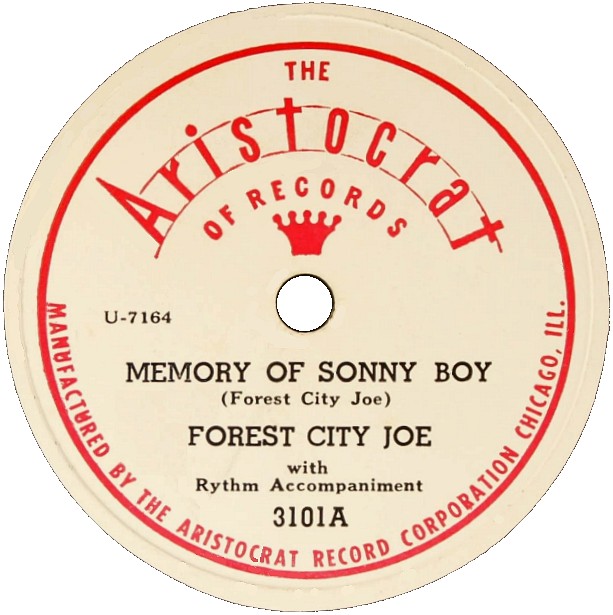
Above Left: Label image of Aristocrat 3101A, recorded in June or July 1948 and released in January 1949. This is Forest City Joe's first record and his only one on the Aristocrat label. He is the composer on both sides. It's another one where the labels misspelled "Rhythm". The top-side is a memorial to the great blues artist "Sonny Boy" Williamson, who was murdered on the streets of Chicago on June 1, 1948. Note that the record was recorded shortly after his death, but not released until about six months later. It may have been produced somewhere else and eventually sold to Aristocrat.
On this record, Forest City Joe sings and plays the harmonica. He's accompanied by jazz guitarist, J.C. Cole.
Above Right: Photo of Forest City Joe, real name "Joe Bennie Pugh", who was a blues singer, and harmonica and piano player. He grew up in Arkansas, moved to St. Louis and then to Chicago in 1947.
At Direct Right: Another photo of Forest City Joe, this time with both harmonica and piano.
CASH BOX REVIEW (1/22/49): FOREST CITY JOE — ARISTOCRAT 3101
Memory Of Sonny Boy/A Woman On Every Street
Music ops in the market for some low-down blues, have a sure thing in this disking by Forest City Joe. Joe's vocal is as low-down as one can possibly get, with the lyrics of the tunes, "Memory Of Sonny Boy" and "A Woman On Every Street" riding thru in fine fettle [condition].Harmonica backing on the pair flavors the platter and keeps it in its slow, dreary vein. Pipes that Joe pitches with are fine and dandy throughout, especially so on the top deck.
While the disk itself may not kick up a storm, ops can depend on the platter to be a consistent and steady nickel nabber. Take a look-see in this direction and then load up.

The Billboard Review (1/29/49): FOREST CITY JOE — ARISTOCRAT 3101
Memory Of Sonny Boy (72) Honest old blues feeling in warbling and harmonica backing on this tribute to a legendary Deep South blues chanter.
A Woman On Every Street (67) More authentic old-style Deep South blues.(NOTE: A ratings range of 40-69 was considered as "satisfactory" and 70-79 as "good".)
LISTEN (Windows Media Player):
1. "Memory Of Sonny Boy" - Forest City Joe - Aristocrat 3101A - 1949.
2. "A Woman On Every Street" - Forest City Joe - Aristocrat 3101B - 1949.BOTH SONGS played in sequence.
EUGENE WRIGHT

|
Above: Photo of Eugene Wright, another Chicagoan who recorded for the Aristocrat label. He was a bassist and bandleader, who had one instrumental record on Aristocrat and backed The Dozier Boys on both sides of another. On one side of the Dozier's record, "Music Goes Round And Round", the vocal group sings only in the first eight seconds of the record and never reappear. That record is included in the Aristocrat Records - Part Two article.
In 1958, Eugene joined the Dave Brubeck Quartet, staying with them for the next ten years.

|
|
CASH BOX, May 28, 1949:
....Looks like Aristocrat Records is buidling up another hit with "Pork And Beans," waxed by Eugene Rice [sic, Wright] and his Dukes Of Swing....CASH BOX, June 25, 1949:
....Aristocrat Records doing a bang up job on their new disk hit, Dawn Mist, waxed by Eugene Wright. Ops acclaim this as one of the top blues numbers of the year....
The Billboard Review (6/18/49):
EUGENE WRIGHT — ARISTOCRAT 11001
Pork 'N Beans (60) Screamer opens with honking one-note bary bust, then a bop trumpet and tram take solos. No unity or build here.
Dawn Mist (60) Ellington–styled mood blues showcases solos of varying quality—the best a trumpet. Section sound not good.(NOTE: A ratings range of 40-69 was considered as "satisfactory".)
LISTEN (Windows Media Player):
1. "Pork 'N Beans (Instrumental)" - Eugene Wright And His Dukes Of Swing - Aristocrat 11001A - 1949.
2. "Dawn Mist (Instrumental)" - Eugene Wright And His Dukes Of Swing - Aristocrat 11001B - 1949.BOTH SONGS played in sequence.

|
CHRISTINE CHATMAN

|

|
Above Left: Photo of Christine Chatman, who played both the piano and accordion. She was also a featured vocalist. Christine was described as "The Sepia Goddess Of Swing" and "The Boogie Woogie Queen". Above Right: ROANOKE TIMES, August 17, 1943. [Christine Chatman]

|

|
Above Left: Label image of Aristocrat 8001 A, recorded in February 28, 1949 and released in May 1949. "When Your Hair Has Turned To Silver" was written by Peter De Rose and Charles Tobias and published in 1930. However, it seems the flip-side, "Hey Mr. Freddy", was truly composed by Christine Chatman.
Above Right: Label image of Aristocrat AR-711, recorded in February 28, 1949 and released in April 1949. Note that all of the above sides were recorded on the same day. So Christine's "All Star Combo" consists of some, if not all, of the musicians from the "Jam Session".
The labels on both sides misspell the guitarist's name, who is Leo Blevins in actuality.
Besides back-up work, Gene Ammons, the tenor saxist, had two records on Aristocrat (under his name alone) in 1950. He is included in the Aristocrat Records - Part One article.
At Direct Right: ATLANTA DAILY WORLD, February 1, 1944:
CHRISTINE CHATMAN, her piano, her accordion, and her orchestra debut in Atlanta, Thursday, Feb. 3 at the Sunset Casino... The band with male personnel and fronted by Christine, comes to Atlanta after successful engagements in Chicago and Indianapolis. Advance, 55c; At Box, 75c. — A South Eastern Attraction.
(NOTE: Wow! Admission at less than the price of one record!)CASH BOX REVIEW (5/7/49):
CHRISTINE CHATMAN — ARISTOCRAT 8001
When Your Hair Has Turned To Silver/Hey Mr. Freddy
A gal that can really pipe a set of lyrics is Christine Chatman. Her offering of "When Your Hair Has Turned To Silver" and "Hey Mr. Freddy" really bears out a fine set of tonsils.Top deck, a standard that has always drawn jitney [nickels], gets a mellow send-off here, with Christine purring the enchanting lyrics in tones that score. Gal’s vocal delivery is warm and rich, and makes you wanna listen.
The flip, "Hey Mr. Freddy", has the thrush piping some stock blues lyrics that play about the title. Top deck for the moola.
LISTEN (Windows Media Player):
1. "When Your Hair Has Turned To Silver" - Christine Chatman - Aristocrat 8001 A - 1949.
2. "Hey Mr. Freddy" - Christine Chatman - Aristocrat 8001 B - 1949.
3. "Three O'Clock Jam Session - Part 1 (Stuffy) (Instrumental)" - Aristocrat AR-711 - 1949.
4. "Three O'Clock Jam Session - Part 2 (Once In A While) (Instrumental)" - Aristocrat AR-711 - 1949.ALL FOUR SONGS played in sequence.

EXTRA RECORDS — CHRISTINE CHATMAN

|

|

|
Above Left: Label image of Decca 48035 A, recorded in April 1944, but not released until 1947. Christine Chatman is one of the composers on both sides. Sam Price, well-known blues and boogie woogie pianist for Decca, is a composer listed on the top side only. The other "composer" shown on both side's labels, J. Mayo Williams, was head of the "race records" department at Decca Records in Chicago. Christine had another record on Decca, also recorded in April 1944, but released in 1944. One side features Mabel Smith [aka Big Maybelle] as vocalist and the flip is an instrumental. The Mabel Smith side, "Hurry Hurry", is available at the King Records - Part Four article.
THE CALL (Kansas City, Missouri), October 8, 1943:
CHRISTINE CHATMAN ACCLAIMED AS "FIND"
DETROIT — On a dance tour for the last six months that has taken her to all parts of the South and Middle West, Christine Chatman and her "Boogie Woogie" crew have been acclaimed by dance and music critics as the year's most outstanding discovery.Practically unknown a few months ago, this young artist of extraordinary talent has been expertly handled by her representatives and is now known and in demand in all parts of the country.
NEW JOURNAL AND GUIDE (Norfolk, Virginia), February 12, 1944:
DECCA SIGNS CHRISTINE CHATMAN
NEW YORK — Christine Chatman, the first lady of "Boogie Woogie", has been signed to cut a few sides for Decca Recording Company sometime in March.CHICAGO DEFENDER, April 8, 1944:
CHRISTINE CHATMAN RECORDS
NEW YORK — Christine Chatman, first lady of "Boogie Woogie", and her Hotter than Hades band waxed four sides for Decca Records Incorporated here this week. The numbers soon will be on the juke boxes everywhere.Above Middle: CASH BOX, September 19, 1953.
Above Right: Label image of Million Dollar 2002A, recorded in August 1948 and released in October 1948. The flip-side song, "Run Gal Run" was composed by "Chatman-Prince", confirmed at BMI.com.
At Direct Right: CALIFORNIA EAGLE (Los Angeles), August 27, 1953.
NOTE: Peppy Prince (bandleader, drums), Christine Chatman (piano, vocals), Little Willie Jackson (alto sax), Art Edwards (bass fiddle), and Eddie Taylor (tenor sax).Opal Nations gives the band members on Million Dollar Records (1953) as Chatman (piano, vocal), Prince (drums), probably Charles Thomas (tenor sax), and Warren McQueen (bass fiddle).
California Eagle, dated July 16, 1953, has Prince (drums), Bill Gaither (tenor sax), Willie Jackson (alto sax), Art Edwards (bass fiddle), and Richard "88" Bailey (piano) in the band.
CASH BOX, October 3, 1953:
..... Jim Warren and Jack Andrews of Central Record Sales report that they are now handling some of the biggest numbers in town, plus many up and comers like Lawrence Stone’s "Please Remember Me" (Modern) and "Run Gal Run" (Million Dollar) with Christine Chatman and Peppy Prince and his Orchestra....Cash Box Review (10/3/53):
CHRISTINE CHATMAN — MILLION DOLLAR 2002
Run Gal Run (B) Christine Chatman makes merry with an infectious and gay calypso type ditty. Orking is in the mood.
Wino's Lament (C+) The fem thrush chants a slow torchy blues. Dreamy and soft lights.(NOTE: A rating of C+ was considered as "good" and B as "very good".)
At Direct Right: Photo of Peppy Prince.
CASH BOX, April 17, 1954:
....Recording artists from all the major recording companies and many of the smaller independent labels swarmed through the doors of Paul A. Laymon Company for the unveiling of the new Wurlitzer "1700".... The Rhythm and Blues field was well represented with Peppy Prince, Christine Chatman, and a new singing group called The Platters....CASH BOX, April 24, 1954:
....Peppy Prince and his Rhythm Lads have a great release with their current waxing of "Honky Tonky" featuring Christine Chatman on the Hollywood label. It’s getting its share of plays here in Los Angeles....LISTEN (Windows Media Player):
1. "Bootin' The Boogie" - Christine Chatman - Decca 48035 A - 1947.
2. "The Boogie Woogie Girl" - Christine Chatman - Decca 48035 B - 1947.
3. "Wino's Lament" - Christine Chatman - Million Dollar 2002A - 1953.
4. "Run Gal Run" - Christine Chatman - Million Dollar 2002AA - 1953.ALL FOUR SONGS played in sequence.

THE NIGHTHAWKS

|
Above: Photo of Robert McCollum aka Robert Nighthawk (center) with pianist Ernest Lane and Robert's wife, drummer Hazel Momon (late 1940s). Robert was a singer, guitarist, bandleader, and songwriter. His first records were on RCA Victor's subsidiary Bluebird as "Robert Lee McCoy" in 1937 and as "Rambling Bob" in 1938. His Nighthawks had two records on the Aristocrat label (1949-1950). Robert then went to United Records in Chicago resulting in two of the first five records released on that newly formed label (1951).

|

|
Above Left: Label image of Aristocrat 2301-B, recorded in July 12, 1949 and released in November 1949. Vocal on all four sides is by Robert McCollum (shown as "McCullum" on the labels). Both "Black Angel Blues" and the flip-side, "Annie Lee Blues", were composed by "Robert Lee McCollum" per BMI.com.
Above Right: Label image of Aristocrat 413, recorded in January 5, 1950 and released in April 1950. Accompaniment on this record is by Pinetop Perkins (piano) and Willie Dixon (bass).
Neither front or back label gives credit to a composer. BMI.com credits "Robert Lee McCullum" for writing "Jackson Town Gal", but not him for "Six Three 0".
At Direct Right: Robert McCollum from the mid-1940s.
CASH BOX, November 5, 1949:
....Aristocrat Records singing praises about their new release, "Annie Lee", as recorded by the Nighthawks, a blues number....LISTEN (Windows Media Player):
1. "Black Angel Blues" - The Nighthawks (Vocal By Robert McCullum) - Aristocrat 2301-B - 1949.
2. "Annie Lee Blues" - The Nighthawks (Vocal By Robert McCullum) - Aristocrat 2301-A - 1949.
3. "Jackson Town Gal" - Nighthawks (Vocal By Robert McCullum) - Aristocrat 413 - 1950.
4. "Six Three 0" - Nighthawks (Vocal By Robert McCullum) - Aristocrat 413 - 1950.ALL FOUR SONGS played in sequence.

EXTRA RECORD — THE NIGHTHAWKS

|

|

|
DUKE JENKINS

|

|
Above: CLEVELAND CALL AND POST, August 29, 1953: OLD COMRADES
Duke Jenkins' combo has been featured in the Majestic Hotel Rose Room for more than a year.In the above pictures, Duke Jenkins And His Band, (L-R) Duke (bandleader, piano), his brother Fred Jenkins (saxophone), Roy Clark (trumpet), and John Brown (drums), who replaced Count Demon in 1950. Another member, Curtis Wilder (bass fiddle), who recently replaced Junior Ragland, is not shown.
Fred had always been a member of any orchestra Duke headed up. Clark, Brown, and Wilder were with Duke when he led bands while in the Air Force.
Duke, whose real name is Herman, got his nickname while playing the piano around Miami University, where his classmates dubbed him a second Duke Ellington.
Every member of the band is a versatile artist in his own right and comprises a floor show in himself. They seldom use a vocalist except on special dance dates as they can put over their own songs.
They served a six-month stretch at the Rose Room and were brought back by popular demand and are now rounding out a year at the popular night spot.
CLEVELAND CALL AND POST, May 19, 1951:
DUKE JENKINS WINS WARM RECEPTION
Duke Jenkins and his talented orchestra completely captivated an enthusiastic audience in the "Blue Monday" morning debut at Cleveland's popular Majestic Hotel Rose Room this week.Led by personable Duke Jenkins (piano), the group, which, on the basis of its evening performance at the E. 55-Central rendezvous, should remain in these parts indefinitely, consists of Junior Raglin (guitarist), Roy Clark (trumpet), John Brown (drums), and Freddie Jenkins (saxophone).
Duke was born October 1, 1915 in Malvern, Ohio. He attended high school at Greentown and attended Miami University at Oxford, Ohio, where he began his musical career by playing in the college band. After leaving the university he played with the Shi Britton and Henry Parrish Orchestras.
Duke later played with the 161st Army band and 191st Army Ground Forces band during World War II. He organized his own band in 1946....

|
Above: CLEVELAND CALL AND POST, May 28, 1955:
SETS RECORD — Duke Jenkins and his Majestic Rose Room Orchestra completed a three-year stint at the local cafe last week setting a record for such combos in the city. Jenkins and his band were brought in from Chicago on May 14, 1952 to succeed Ralph Wilson and his orchestra.The band includes (left to right) John Brown, Roy Clark, Freddine Jenkins, Curtis Wilder, and Duke Jenkins (at the piano). The combo has just completed their first recording for a national label, "Mambo Blues", which critics predict will be a sensational hit.
(NOTE: Duke's band continued performing at the Rose Room for at least two more years. Their first engagement in Cleveland was at the Cafe Tia Juana in April 1950. "Mambo Blues" was released in July 1955 on the Pennant label, located in Birmingham, Alabama. It's included further below.)

|

|

|
CASH BOX REVIEW (8/27/49):
DUKE JENKINS — ARISTOCRAT 811
Bercuese/Baby I'm Sick Of You
In medium slow tempo and with a rendition of "Bercuese" that’s bound to win him many and many a follower, Duke Jenkins cuts wax here that has plenty of possibilities to go ’way over the top.On the flip, handling the vocal himself, the Duke turns in one of the best cuttings heard around featuring most unusual lyrics in a tempo that has beat and rhythm and plenty of that nickel grabbing stuff cut right into it for juke box play. Buy a boxful.
THE BILLBOARD REVIEW (8/20/49):
DUKE JENKINS ARISTOCRATS — ARISTOCRAT 811
Bercuese (70) An expressive alto sax wails its way thru a moody opus that sounds like a composite of several Ellington works. An easy-going, danceable disk.
Baby I'm Sick Of You (67) Nothing special here. Fairly amusing number, but no guts in the recording sound.(NOTE: A ratings range of 40-69 was considered as "satisfactory" and 70-79 as "good".)
EXTRA RECORD — DUKE JENKINS

|

|

|
|
BLUES ROCKERS

|
Above: CHICAGO DEFENDER, August 5, 1950:
EARL DRANES and his Blues Rockers are currently featured at Sam Evans' Ebony Lounge, 444 W. Chicago Avenue. The hot spot is extremely popular with near North Side wine and dance patrons.NOTE: The Blues Rockers on Aristocrat consisted of James Watts (vocals), Willie Mabon (piano, vocals), Eddie El (guitar), and Earl Dranes (bass). Mabon, who moved on to a successful blues singer career, is not in the above photo.
FROM GOOGLE ARTIFICIAL INTELLIGENCE:
Willie Mabon moved to Chicago in 1942 and formed The Blues Rockers, joining Aristocrat Records around 1949. The lineup included Willie Mabon (piano/vocals), Fred Clark (tenor sax), Joseph "Cool Breeze" Bell (bass), and Steve Boswell (drums).
(NOTE: Accept the above as facts at your own risk!)

|

|
Above Left: Label image of Aristocrat 407, released in December 1949. These two sides were recorded by famous Chicago disk jockey Al Benson and sold to Aristocrat. Benson later owned the Parrot and Blue Lake labels. It's probably James Watts singing lead on "Trouble In My Home". Willie Mabon has the honor on the flip-side.
The labels on both sides credit "Blues Rockers" as the composers. Neither song was registered at BMI.
Above Right: Label image of Aristocrat 415, recorded in March 1950 and released in May 1950. Again, neither song was registered at BMI.
These are the only two records by the Blues Rockers on the Aristocrat label. They did have one record released on Atlantic Records' subsidiary label, Plaza, in October 1949.
CASH BOX, January 14, 1950:
....Phil Chess, Aristocrat Records reports that "Times Are Getting Hard", waxed by the Blues Rockers, clicking very big on the Southside....At Direct Right: THE BILLBOARD, January 21, 1950.
At Far Right: Photo of Willie Mabon at the piano.
THE BILLBOARD REVIEW (1/28/50):
BLUES ROCKERS — ARISTOCRAT 407
Trouble In My Home (60) Up tempo boogie novelty with weak solo and unison vocal work doesn't jell despite strong honky piano underneath.
Times Are Getting Hard (52) Slow blues, with ork chanting responses to solo warbler, isn't projected.(NOTE: A ratings range of 40-69 was considered as "satisfactory".)
LISTEN (Windows Media Player):
1. "Trouble In My Home" - Blues Rockers - Aristocrat 407 - 1950.
2. "Times Are Getting Hard" - Blues Rockers - Aristocrat 407 - 1950.
3. "When Times Get Better" - The Blues Rockers - Aristocrat 415 - 1950.
4. "Blues Rockers' Bop" - The Blues Rockers - Aristocrat 415 - 1950.ALL FOUR SONGS played in sequence.


|
EXTRA RECORDS — WILLIE MABON

|
Above: Photo of Willie Mabon. His big hit, "I Don't Know", was first released on the Parrot label and then sold to Chess. It first hit The Billboard R&B chart at #2 (12/20/52), then #1 (12/27/52), staying in that position for eight weeks before dropping back to #2 (2/21/53). More about "I Don't Know" is in the Parrot Records - Part Two article. Willie stayed with Chess resulting in a total of nine records for them (1952-1956).

|

|
Above Left: Label image of Apollo 450, released in 1949. "Big Willie" is actually Willie Mabon. It's his only record on the Apollo label. Neither side's label shows any composer. BMI.com credits "It Keeps Raining"" (the flip-side) to "Willie Malborn".... close enough? Above Right: Label image of Chess 1580, released in 1954. This is a different "Poison Ivy" than the Leiber-Stoller hit song by The Coasters. BMI.com lists over 225 "Poison Ivy" song titles. This one was composed by Melvin London. The flip-side, "Say Man", was written by Willie James Mabon and Odie Payne Jr.
CASH BOX, October 30, 1954:
....Four new releases on Chess ’n Checker this week have the Chess boys working like mad. As a matter of fact, Phil currently is on the East Coast. The disk which has Len most excited is Willie Mabon’s new Checker [sic Chess], titled "Poison Ivy" b/w "Say Man." Second on Checker [sic Chess], by the newly-signed Moonglows, called "Sincerely" b/w "Tempting" which, Len says, the ‘Glows’ deliver in a smooth manner.Len also looking for big things to happen to Lowell Fulsom’s debut disk on the Chess [sic Checker] label. It's titled "Reconsider Baby". Finally, a disk cleverly titled "Shoo Doo Be Doo" b/w "So all Alone" by Bobby Lester and The Moonlighters [on Checker]. Looks like the Chesses are starting off the fall season in grand fashion (again!!!)....
At Direct Right: CASH BOX, November 6, 1954.
NOTE: A good selection, but not close to "The Nation's Top 4".CASH BOX, November 6, 1954:
....Willie Mabon has his best in several releases with "Poison Ivy" and "Say Man". This one could be the one to put Willie back into the charts and heavy sales....CASH BOX REVIEW (11/6/54):
WILLIE MABON — CHESS 1580
Poison Ivy/Say Man
Willie Mabon makes a pitch for the big sales with his best in some time. Material is a middle beat jump item with a strong set of lyrics and good delivery. Deck should stir things up. Poison Ivy looks like the big side. On the flip, Mabon sings another jump item with zest and comes up with another strong side. The chanter has a two sider contender.THE BILLBOARD REVIEW (1/28/50):
WILLIE MABON — CHESS 1580
Poison Ivy (76) Mabon warns his competitors that he will be all over them like poison Ivy if they don't leave his girl alone. The lyrics have a humorous twist, and in Mabon's relaxed delivery, backed by an easy but insistent beat, are persuasively sold.
Say Man (71) Mabon is belligerent here, too, but lyrics and melodic riff not so strong as on the flip. The singer is in there pitching and gets vigorous, swingy backing by the ork.(NOTE: A ratings range of 70-79 was considered as "good".)
LISTEN (Windows Media Player):
1. "Bogey Man" - Big Willie - Apollo 450 - 1949.
2. "It Keeps Raining" - Big Willie - Apollo 450 - 1949.
3. "Poison Ivy" - Willie Mabon - Chess 1580 - 1954.
4. "Say Man" - Willie Mabon - Chess 1580 - 1954.ALL FOUR SONGS played in sequence.

GOSPEL RECORDS
Aristocrat Records produced little in the gospel/spiritual field. Their total output was two records by the Seven Melody Men (1947-1948), one, possibly two, by Rev. "Gatemouth" Moore (1949), and one each by the Norfolk Singers (1949), the Blue Jay Singers (1949), and Sammy Louis [sic Lewis] (1950). THE BILLBOARD, July 9, 1949:
SHAW PREPARES GOSPEL PACKAGE
NEW YORK—With Sister Rosetta Tharpe and Marie Knight regularly showing that religious music pays off at the box office, booker Billy Shaw, chief of the Shaw Artists Corporation, has put together a gospel package featuring Rev. Dwight (Gatemouth) Moore, who recently turned to religious music after a lengthy career as a blues shouter. The package will also spot the Victoria Boys, Ernestine Washington, and singing Sammy Lewis.

|
Above: Photo of Seven Melody Men, a name they used for their Aristocrat releases. They were actually the "Four-A Melody Men", a St. Louis group who had been around since the mid-1930s.

|

|
Above Left: Label image of Aristocrat 901-A, recorded in August 1947 and released in December 1947. Above Right: INDIANAPOLIS RECORDER, October 20, 1945.
LISTEN (Windows Media Player):
1. "Rockin' Lord" - Seven Melody Men - Aristocrat 901-A - 1947.
2. "Nobody Knows-Nobody Cares" - Seven Melody Men - Aristocrat 901-B - 1947.BOTH SONGS played in sequence.

|
Above: Photo of Rev. Dwight Gatemouth Moore, circa 1957 . He made his first recordings for Kansas City's Gilmore's Chez Paree label in 1945, which included his signature song, "I Ain't Mad at You, Pretty Baby". Gatemouth then moved to National Records (1945-1946), followed by King Records (1947-1948). Following his 1949 stint with Aristocrat, he worked as a religious disk jockey in Memphis, Tennessee
NEW JOURNAL AND GUIDE (Norfolk, VA), January 8, 1949:
GATEMOUTH MOORE TO ENTER THE MINISTRY
CHICAGO, ILL.—Dwight "Gatemouth" Moore, popular blues singer and recording artist, announced this week he was retiring from singing and is going into the ministry.Mr. Moore, who is best known for his recording of "Somebody's Got To Go", closed a lengthy engagement this week at Club DeLisa. The blues singer stated he could serve humanity better by preaching the word of God.
At Right: Label image of Aristocrat 905A, recorded in circa April 1949 and released in July 1949. Gatemouth did record two more sides for Aristocrat, which were released on Chess 1437 in 1950.
A European release of this record, on Denmark's Vogue label, credits "Moore" as composer of "The Bible's Being Fulfilled" and "Traditional" on "Glory, Glory, Hallelujah".
THE BILLBOARD, June 11, 1949:
....Dwight (Gatemouth) Moore is a singing evangelist in Chicago and is cutting sacred songs for Aristocrat Records, with choir backing....LISTEN (Windows Media Player):
1. "The Bible's Being Fulfilled Every Day" - Rev. "Gatemouth" Moore - Aristocrat 905A - 1949.
2. "Glory, Glory, Hallelujah" - Rev. "Gatemouth" Moore - Aristocrat 905B - 1949.BOTH SONGS played in sequence.

EXTRA RECORD — GATEMOUTH MOORE

|

|
Above Left: Photo of Gatemouth Moore, the blues singer. Above Right: THE CALL (Kansas City, Missouri), May 28, 1943. [Gatemouth Moore]
NOTE: Gatemouth's first records were on the Gilmore's Chez Paree label. His last record for them is "I Ain't Mad At You, Pretty Baby" backed with "Somebody's Got To Go (It Ain't None Of Me)".

|

|
Above Left: Label image of National 6001-A, released in October 1945. "Dwight Moore" is the composer on both sides. This record is the same two songs that Gatemouth did on Gilmore's Chez Paree #855, except redone for National Records. "I Ain't Mad At You, Pretty Baby" was also released by the Flennoy Trio in 1945, on Excelsior Records. That label credits "Jimmie Edwards", their guitar player, as the songwriter.
Above Right: NEW JOURNAL AND GUIDE (Norfolk, Virginia), May 11, 1946:
DWIGHT "Gatemouth" MOORE — Blues Sensation of the NationAt Direct Right: THE BILLBOARD , December 29, 1945.
NOTE: The 5000 series, including some other country and western and some polka, but mostly Dick Thomas (c&w), was significantly lower priced.THE BILLBOARD REVIEW (11/24/45):
GATEMOUTH MOORE — NATIONAL
I Ain't Mad At You, Pretty Baby/It Ain't None Of Me
The race blues shouting by Dwight (Gatemouth) Moore, singing it low down about the two-timing and back-biting women, rings the bell for the race registers. Even becomes violent in his vocal rantings for "I Ain't Mad at You, Pretty Baby", going slow and low for his someone's–gotta—go blues in "It Ain't None of Me".Dallas Bartley and his Small Town Boys, a small jam combo, provides adequate musical support. Sides are geared for maximum play at race locations, particularly "It Ain't None of Me"
CASH BOX didn't review this record, but THE BILLBOARD reviewed it twice to make up for that:
THE BILLBOARD REVIEW (12/22/45):
GATEMOUTH MOORE — NATIONAL
I Ain't Mad At You, Pretty Baby/It Ain't None Of Me
For the race blues shouting about the back-biting women, "Gatemouth" (Dwight) Moore brings some real blues excitement to the spinning sides. In the lively tempo tells his chick "I Ain't Mad at You, Pretty Baby", only she had better change her ways, and then gets real low-down and groovy as he gives out slower and salty for "It Ain't None of Me", an effective variation of the familiar someone's–got–to–go blues.Moore fashioned both blues himself, and added to the heating qualities of his singing is the righteous rhythmic support from Dallas Hartley and His Small Town Boys.
The phono fans at the race locations will run riot for both of these sides.
LISTEN (Windows Media Player):
1. "I Ain't Mad At You, Pretty Baby" - Gatemouth Moore - National 6001-A - 1945.
2. "It Ain't None Of Me" - Gatemouth Moore - National 6001-B - 1945.
3. "I Ain't Mad At You, Pretty Baby" - Gatemouth Moore - Gilmore's Chez Paree D-855-B - 1945.ALL THREE SONGS played in sequence.

PART FOUR concludes this series of articles about ARISTOCRAT RECORDS.
OTHER ARTISTS to have records on Aristocrat, but are not covered in this four-part series of articles, include Lee Monti's Tu Tones, Hollywood Tri Tones, Forrest C. Sykes, Danny Knight, Jerry Abbott, Duke Groner, Penny Smith, Jimmy Bell, Dick Hiorns, Skeetz Van Orchestra, Little Johnny [Jones], and Laura Rucker.
EPILOGUE Aristocrat Records was reborn as Chess Records in mid-1950. Leonard and his brother, Phil, were now the co-proprietors.
Charles Aron (picture at left) and his wife, Evelyn Aron, formed Aristocrat in 1947. Charles left Aristocrat in early 1949 resulting in Leonard Chess becoming President and Evelyn Vice President-Secretary.
In 1949 Evelyn also left Aristocrat to form American Distributing Company (also known as American Record Distributers) with Art Sheridan (who later formed and was President of Chance Records in Chicago). (At Right: Cash Box 12-17-49.) Evelyn and Art were married on December 16, 1949.
Dave Clark, who was Head of Sales Promotion for Aristocrat, continued on in that capacity for the Peacock, United, States, and Ronel labels.
Several of the artists that recorded for Aristocrat continued to have records released on the Chess label. This includes Gene Ammons, Sax Mallard, Christine Chatman, Jimmy Bell, Muddy Waters, the Dozier Boys, Rev. Gatemouth Moore, Floyd Smith, Tom Archia, Blues Rockers, Robert Nighthawk, Jimmy Rogers, and Willie Mabon.
There were only two vocal groups that had records issued on the Aristocrat label, the Dozier Boys and the Five Blazes. After leaving Aristocrat/Chess, the Dozier Boys had two records released on Chicago's United Records , both in 1953.
The Five Blazes also went to United Records. As the "Four Blazes", they had six records for United in 1952 to 1954. Also on United, one record as "Tommy 'Mary-Jo' Braden And His Flames" (1954) and one as The Blases (1955).
Sunnyland Slim went on to have records with Apollo (1950), Regal (1951), Mercury (1952), Blue Lake (1954), Club 51 (1956), and Cobra (1957).
Robert Nighthawk And His Nighthawks are another ensemble that went to United resulting in two records on that label (1951). Also, Gene Ammons and his tenor saxophone had five records on United (1952-1954).
Duke Jenkins had records on the Tick Tock (1952), Pennant (1955), Kent (1956), and Cobra (1957) labels. After leaving Chess in 1956, Willie Mabon went to Federal Records (1957).


|
NOTE: Restoration of photos, clippings, record label images, and audio is by Tony Fournier.
THIS ARTICLE'S MAIN INFORMATION SOURCES:
Robert L. Campbell's Red Saunders Research Foundation Websites.
The Billboard and Cash Box Magazines.
Ferdie Gonzalez' Disco-File.
Newspapers.com.
ARISTOCRAT RECORDS - PART ONE FEATURES ARISTOCRAT'S BEGINNINGS. ARTISTS INCLUDED ARE SHERMAN HAYES, WYOMA WINTERS, THE 5 BLAZES, JACKIE CAIN, GEORGE DAVIS, ROY KRAL, JUMP JACKSON, MELROSE COLBERT, TOM ARCHIA, SHEBA GRIFFIN, BENNY KELLY, JO JO ADAMS, GENE AMMONS, AND FLOYD SMITH. ARISTOCRAT RECORDS - PART TWO FEATURES IN-DEPTH COVERAGE OF CLARENCE SAMUELS, ANDREW TIBBS, THE DOZIER BOYS, PRINCE COOPER TRIO, AND SAX MALLARD ORCHESTRA.
ARISTOCRAT RECORDS - PART THREE FEATURES IN-DEPTH COVERAGE OF SUNNYLAND SLIM, MUDDY WATERS, LEROY FOSTER, AND ST. LOUIS JIMMY.
1. "Memory Of Sonny Boy" - Forest City Joe - Aristocrat 3101A - 1949.
ALL TWENTY-FOUR ABOVE ARISTOCRAT AND CHESS LABEL SONGS played in sequence. At Right: THE BILLBOARD, August 10, 1946.
|

|
Last Update: February 12, 2026
E-mail Me:
